Paris-based President Emmanuel Macron opened the “Africa Forward: Africa-France Partnerships for Innovation and Growth” summit in Nairobi on Monday, advocating for a transition from aid to private investment in Africa. Speaking to an audience of university students and business leaders at the University of Nairobi, Macron emphasized that the continent “needs investment to become more sovereign.” He argued that Europe should replace traditional development assistance with genuine economic opportunities, stating that the previous approach of lecturing African leaders about their needs is “no longer what Africa wants to hear.” Macron candidly acknowledged that “we, too, no longer have the means” to sustain the old model of aid.
In interviews with Jeune Afrique and The Africa Report prior to the two-day summit, Macron reiterated France’s condemnation of colonialism, a stance he has maintained since the beginning of his presidency in 2017. However, he also warned that the decades following independence have contributed to many of today’s challenges. He urged African governments to enhance governance and manage resources with greater transparency. While recognizing the criticism directed at former colonial powers like France and the United Kingdom, Macron contended that Europe is not “the predator of this century.” He positioned the European Union as a defender of the international order, multilateralism, rule of law, and open trade, contrasting this with what he described as a “trade standoff” between the United States and China, where “rules are not respected.”
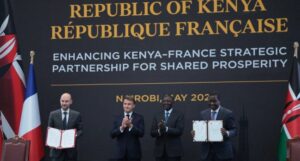
On the topic of critical minerals, Macron accused China of adopting a “predatory logic” by processing raw materials domestically and creating dependencies for the rest of the world. The summit, which included French officials such as Foreign Affairs Minister Jean-Noël Barrot and Kenyan President William Ruto, aimed to revive France’s engagement with Africa after a period of strained relations. Macron highlighted a proposed overhaul of international finance that would establish financial guarantees to attract private capital into African projects, particularly in renewable energy and nuclear power. Photographs from the event captured Macron and Ruto signing bilateral agreements at Kenya’s State House.
In a separate segment of his remarks, Macron addressed France’s military withdrawals from Mali, Burkina Faso, and Niger following coups between 2020 and 2023. He characterized the decision to leave as a “logical response” to the loss of a host-government invitation, rather than a humiliation. Macron expressed confidence that the Sahel would eventually return to “normal governance” under democratically elected leaders who genuinely serve their populations. The summit concluded with a call for a “strategy of autonomy” for both Europe and Africa, aiming to reduce dependence on external powers while fostering mutually beneficial partnerships. Observers noted that the event signifies a notable shift in French policy, seeking to align European investment with African priorities and to position the continent as a partner rather than a mere recipient of aid.