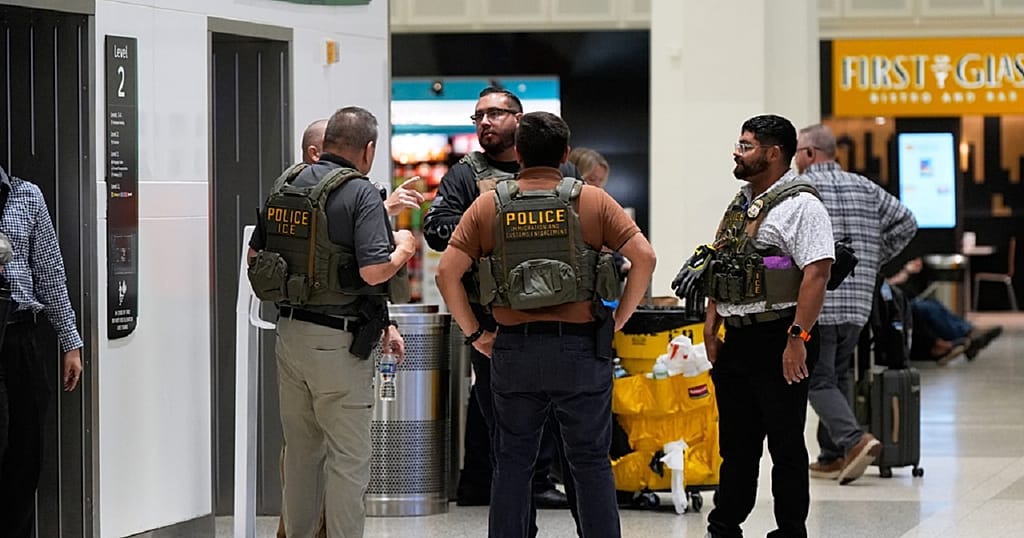
The United States has confirmed that Immigration and Customs Enforcement (ICE) agents will not be deployed inside or around stadiums hosting matches for the 2026 FIFA World Cup. This decision follows concerns that immigration enforcement operations could intersect with fan zones and venue perimeters during the tournament.
Earlier this year, the presence of ICE officers at large domestic sporting events sparked significant debate. In response, the Trump administration announced that ICE would play a “key part” in security operations for the World Cup, focusing on homeland-security investigations. However, this announcement raised apprehensions among members of Congress and several labor unions, who feared that immigration raids might occur near match venues, potentially disrupting both spectators and participants.
The 2026 World Cup will be jointly hosted by the United States, Canada, and Mexico, spanning more than a dozen North American cities. In light of the public outcry, Acting ICE Director Todd Lyons clarified the agency’s limited role. Officials from the tournament’s organizing committee have since secured guarantees that ICE personnel will not be stationed inside stadiums during games.
Rodney Barreto, co-chair of the Miami host committee, stated that federal authorities have assured against any “round-them-up” style enforcement at match sites. He also mentioned a conversation with U.S. Secretary of State Marco Rubio, who indicated that the federal government would assist with processing travel documents for fans entering the United States for the event.
This clarification is expected to alleviate tensions among supporters, advocacy groups, and local authorities, allowing security planning to focus on traditional public safety measures rather than immigration enforcement. Organizers remain committed to providing a safe and welcoming environment for the estimated 1.8 billion global viewers and the millions of fans expected to travel to North America.
As the tournament approaches, effective coordination between FIFA, local law enforcement agencies, and U.S. federal bodies will be essential to ensure seamless operations across the multiple host cities. The firm stance on ICE’s non-presence at stadiums highlights a broader effort to separate immigration policy from the execution of international sporting events, potentially setting a precedent for future global competitions.