
The U.S. military has killed more than 200 people in strikes on boats in the Caribbean and Eastern Pacific over the past nine months. Legal experts and former military lawyers broadly agree these strikes constitute illegal military orders that service members should refuse to follow. While no troops have publicly refused, at least a handful have sought legal advice through anonymous hotlines for U.S. military members, grappling with the ethics and legality of their actions.
Before the Trump-era boat strikes began, the United States treated the drug trade as a law enforcement issue, tasking the Coast Guard with interdicting drug-laden boats. Since then, the Trump administration has released no evidence that the targeted boats carried drugs or that their occupants were linked to drug cartels. The identities of those killed remain largely unknown, with only a few names appearing in news reports. Family members have filed a federal lawsuit, alleging their relatives were murdered by the United States.
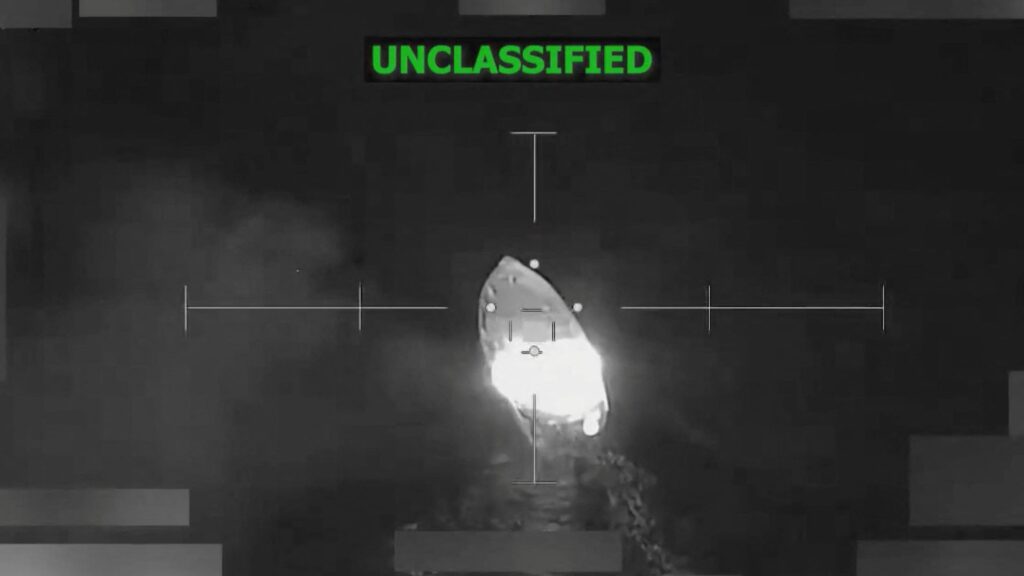
The military has posted dozens of grainy, black-and-white videos of the attacks on social media, showing boats speeding through water before exploding into flames. Trump officials maintain the strikes are lawful. At a June 2 Senate budget hearing, Secretary of State Marco Rubio stated, “Every boat strike has a legal officer on the deck that has to make a determination about whether the call is legal or not.”
The Pentagon referred questions to U.S. Southern Command, which oversees operations in South America and the Caribbean. The command said in a statement, “All operations are conducted deliberately and lawfully, in full compliance with U.S. and international law, including the law of armed conflict. All targeting criteria are developed according to legal, operational, and intelligence requirements.”
Since the first strike on Sept. 2, scores of legal experts and former military lawyers have characterized the strikes as extrajudicial killings or murders. U.S. law requires military members to refuse illegal orders. Dan Maurer, a retired Army lieutenant colonel and former military lawyer, said, “It’s going to be a shameful episode in the history of American military operations, and I hope it becomes a case study in what not to do.”
Two organizations providing anonymous legal advice for military members said they received calls from service members concerned about the strikes’ legality, some directly involved. Steve Woolford, a resource counselor with Quaker House and the GI Rights Hotline, spoke with about four service members. One discussed planning a strike, while two others were ordered to execute them. Woolford recalled one caller saying, “I think this is exactly what was described as a war crime.” Callers are “more scared now that they’d be punished if they did bring something up,” he added.
Brenner Fissell, vice president of the National Institute for Military Justice, said the Orders Project receives a “steady but small number of calls,” including from service members concerned about the boat strikes. Some expressed a “sense of being asked to do things that one is deeply conflicted with the morality of doing.” He noted a “general perception that no one is ever going to be prosecuted for this because Trump will be able to issue pardons preemptively.”
If a service member refuses an order, the case may go to a military judge. But before that, they could be removed from duty immediately. Eugene Fidell, who teaches military law at Yale Law School, said the Pentagon could scrap charges about illegal orders. Trump could also preemptively pardon service members. “The next administration might find its hands tied in terms of prosecuting anybody for obeying such an order, because President Trump may pardon everybody in sight,” Fidell said.
Service members objecting to war can seek conscientious objector status. Mike Prysner, director of the Center on Conscience and War, said more than 100 people have contacted the nonprofit since late February. Asked whether any service members refused orders or were reprimanded, U.S. Southern Command said it “does not comment on unconfirmed reports, speculation, or administrative matters.”
Speculation surrounds the early retirement of Adm. Alvin Holsey, who led U.S. Southern Command through the first months of the strikes. Holsey left after barely a year in December. He hasn’t spoken publicly, but some outlets reported he raised concerns. The strikes and social media videos have continued under Gen. Francis Donovan, Holsey’s successor.
Six Democratic lawmakers released a video last year urging service members to disobey illegal orders. The FBI investigated, and the Pentagon moved to punish retired Navy captain Sen. Mark Kelly. A federal appeals court blocked the charges. Anti-war veterans groups put up billboards near U.S. Southern Command’s headquarters in Doral, Florida, showing images of the hit boats. “Don’t let them make you break the law,” one read.
Concerns boiled over after reports that the first boat strike in September left two survivors, whom the military killed in a second “double-tap” strike about 40 minutes later. The Pentagon refuses to release footage of that second strike. Lawmakers who viewed it in a classified setting called it deeply disturbing. Rep. Jim Himes, the top Democrat on the House Intelligence Committee, said, “What I saw in that room was one of the most troubling things I’ve seen in my time in public service. You have two individuals in clear distress – without any means of locomotion, with a destroyed vessel – who were killed by the United States.”
International law prohibits killing wounded adversaries or those who have surrendered. However, many experts say the strikes can’t be considered war crimes because the Trump administration’s claim of being at war with drug cartels doesn’t hold up. Maurer said he finds it “highly improbable” that a future administration would prosecute service members, due to the military’s popularity and lack of appetite for a “retribution campaign.” “I don’t think criminal accountability is going to happen,” he said.
The mother and sister of Chad Joseph and Rishi Samaroo, two Trinidadian men allegedly killed in an Oct. 14 boat strike, have sued the U.S. government for damages over “wanton, willful, and outrageous killings.” Relatives of Alejandro Carranza Medina, a Colombian man killed in a September strike, filed a complaint with the Inter-American Commission on Human Rights seeking compensation.
Steven Lepper, a retired Air Force major general who organized a working group of former military lawyers after Pentagon chief Pete Hegseth fired top lawyers, said he believes service members who participate in or observe illegal orders will normalize them. “We are desensitizing the military to the notion that the orders they’re being given may be unlawful.”




Comments are closed for this story.