The battle for California’s next governor is set. Democrat Xavier Becerra and Republican Steve Hilton have clinched the top two spots in the state’s chaotic primary, as projected by the Associated Press and NBC News. The race, decided on June 2 but only called a week later on June 9, saw the two frontrunners emerge from a nonpartisan “jungle” primary where only the top two vote-getters, regardless of party, advance to November’s general election. They’ll vie to succeed Governor Gavin Newsom, who terms out in January after eight years.
Billionaire Democratic activist Tom Steyer landed in third, trailed by Riverside County Sheriff Chad Bianco and former Congresswoman Katie Porter, per the outlets. Becerra, a former Health and Human Services Secretary, and Hilton, a former Fox News contributor, survived a staggering field of 61 candidates that stretched across a nearly two-foot-long ballot. Steyer, a progressive billionaire and climate crusader, also made the cut among the pack.
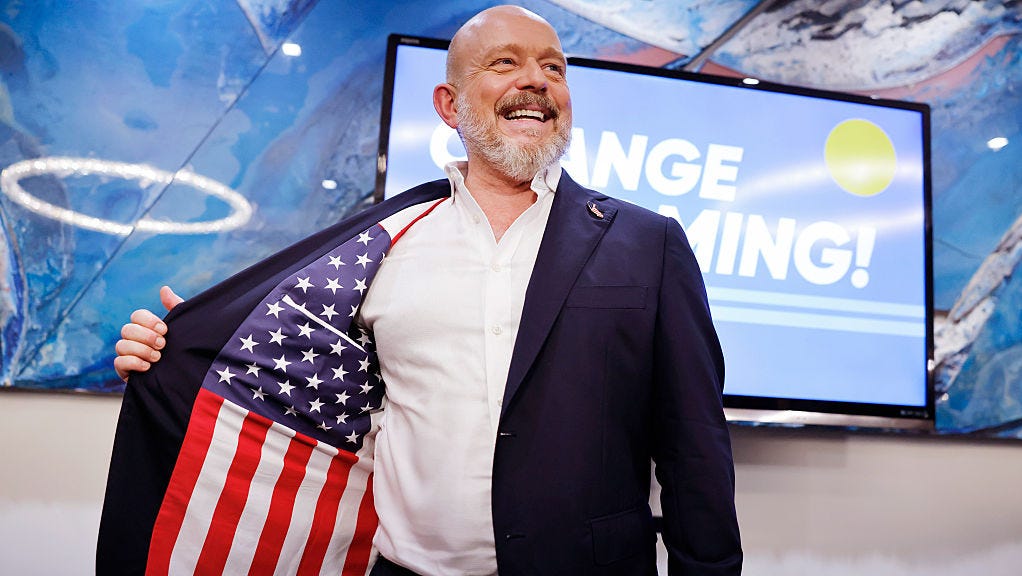
“The people of the great state of California, in the greatest nation on earth, have spoken – loudly and proudly,” Becerra declared on June 5, after being announced as the first to advance. “We will not be bought. We will not be bullied. And we are never backing down. November, here we come.” Hilton, endorsed by President Donald Trump, remained bullish about his top-two finish. He’s already challenged Becerra to join him on the trail to overhaul the state’s voter ID process. “Change is coming,” Hilton told supporters in San Mateo on June 5. “We can’t go on like this. Thanks to this election, we see now change is coming. A belief that we can be the best in everything. The best place to raise a family. The best place to start a business.”
With over five dozen contenders, from seasoned politicians like Porter to unknowns like U.S. Army reservist Barack D. Obama Shaw, the field has “finally whittled down” to the two candidates most expected for about a month, said David McCuan, a political science professor at Sonoma State University. “This race had about a 75% to 80% chance of being between these two candidates,” McCuan noted. “It’ll be a huge proxy war of an existential crisis that is for the midterm elections for Democrats versus the Hilton proxy that is Trump 2.0.”
After early voting followed the June 2 primary, Becerra, Hilton, and Steyer rose to the top as many leading candidates dropped out. That included Democrats Porter, ex-Los Angeles Mayor Antonio Villaraigosa, state Superintendent of Public Instruction Tony Thurmond, and San Jose Mayor Matt Mahan, a latecomer who raised about $30 million, much from Silicon Valley tech insiders. At nearly $316 million, the governor’s race is the most expensive on record and the fifth-most expensive non-presidential race for ad spending, according to AdImpact. Steyer’s campaign alone spent over $200 million, accounting for 64% of every dollar spent. Still, it wasn’t enough to break through the top two, McCuan concludes. “Steyer continues the difficult stretch that well-off, rich candidates have in the Golden State,” he said. “They are far, far better off moving issues over candidates – especially their own political fortunes.”
Becerra, a moderate Democrat who six weeks ago was in single digits in several polls, gained momentum after former U.S. Rep. Eric Swalwell dropped out in April amid sexual assault allegations, which he denies. Becerra leaned on his experience, steadily climbing in the polls with a platform focused on lowering costs for health care, housing, child care, and utilities, while fighting Trump. Steyer targeted Becerra in ads, calling him a “corporate Democrat,” but Becerra rose from the ruins and heavy criticism. With over 20 years in Congress, Becerra capitalized on loyal Democratic voters, Latinos, and independents, said Rusty Hicks, California Democratic Party chair, in a recent interview. At his campaign party in Los Angeles, Becerra told supporters he’d defied the odds, despite being outspent and advised to drop out. “Well, guess what? The underdog stayed in the fight,” he said. “The true spirit of democracy is this: After all of the exhausting ads are run, the pundits are spun, and the billionaires try to buy their way in, it’s the people, only the people who get the last word… Loudly and proudly.”
Hilton, the political newcomer who topped many polls for months and earned Trump’s endorsement, seemed likely to make the cut. He stayed in the top two despite pre-primary polls showing Becerra and Steyer gaining ground. “I thought, ‘Is that a little premature to write the words “change is coming”?’” Hilton told cheering supporters at his June 2 campaign party in Huntington Beach. “I don’t think so, because change is coming. Change is coming to California, and it’s long overdue.” On June 5, Hilton demanded Newsom immediately establish an “Emergency Election Support Corps” to speed up ballot counting, calling the state the “laughingstock of the nation when it comes to election reporting.” Newsom’s office responded, saying the governor also “wishes the vote count moved faster, too,” but noted he doesn’t administer elections or count ballots—those duties fall to local officials under the secretary of state.
The final primary results arrived after Trump scrutinized the slow count. In Truth Social posts last week, he baselessly claimed Democrats are “stealing the vote” in the governor’s race. That was followed by Bill Essayli, first assistant U.S. attorney for California’s Central District, announcing multiple investigations into potential election fraud in Los Angeles on June 5. Later that day, the Department of Justice sent an attorney to observe ballot processing in Los Angeles, the county’s elections office told USA TODAY. Mike Sanchez, a spokesman for the Registrar-Recorder office, said the process is open to public observation, and the attorney was given an overview and walkthrough.
But We Are California, a coalition of community and advocacy organizations, fired back with an open letter denouncing Trump’s attacks. “California’s pro-voter protections were fought for and won by generations of Californians who understood that the vote is the most direct way we have to make decisions about our lives,” the nonprofit wrote. “The vote count takes time because every vote is counted. In the coming months, we will face more attacks. We must be ready to protect our votes. We are not going to let anyone – including the President of the United States – take that from us.”
Both candidates will now zigzag across California campaigning for the next five months. Becerra could become the state’s first elected Latino governor in over a century, while Hilton could be the first Republican governor since Arnold Schwarzenegger left office in 2011. California, the nation’s most populous state with roughly 12% of the population, has about 23 million registered voters—nearly half Democrats and a quarter Republicans, with the rest independents or no party preference, per the Public Policy Institute of California. Whoever wins will manage a state with a roughly $4 trillion budget, the world’s fourth-largest economy, along with multibillion-dollar debt, Medicaid access amid federal cuts, high housing costs, homelessness, and the persistent threat of wildfires.