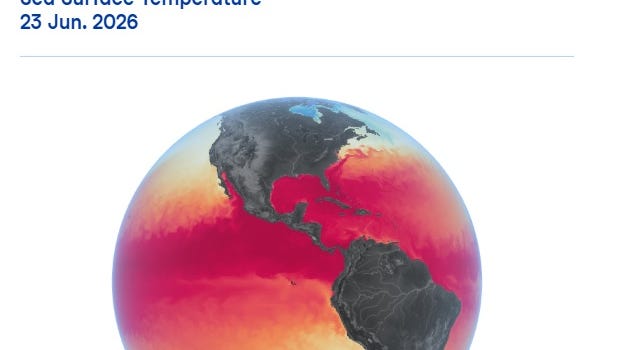
The Pacific Ocean is sending a clear signal. Sea surface temperatures in the equatorial Central and Eastern Pacific have shattered daily warm records for more than 20 consecutive days in June. Scientists now warn this could become one of the most powerful El Niño events ever observed.
The numbers are stark. Ocean temperatures in the El Niño region aren’t just above normal—they’re the hottest ever recorded for this time of year, and nearly the warmest for any season. Kevin Trenberth, a climate scientist at the National Center for Atmospheric Research, confirms El Niño is fully underway. The upper layer of the ocean in that zone is now more than three degrees Fahrenheit above average.
This natural climate cycle is already flexing its muscles. Daniel Swain, a climate scientist with the University of California Agriculture and Natural Resources, noted during his June 17 WeatherWest podcast that El Niño is actively reshaping conditions along the equator. When those waters heat up, the pattern locks into the atmosphere, shifting trade winds, jet streams, and global weather systems.
Its ripple effects will touch nearly every corner of the planet. For some regions, that means heightened risks of costly extreme weather: tornadoes, winter storms, and back-to-back rainstorms that trigger floods and landslides. For others, El Niño brings relief—beneficial rain and fewer tropical storms and hurricanes. Either way, this climate driver will dominate headlines through 2026 and beyond.
Here are five critical reasons why experts say this event demands attention.
First, El Niño is a master redistributor of heat. It doesn’t just push warm water around randomly. As Trenberth explains, it moves heat that builds up in the tropical Pacific toward higher latitudes, where it’s released into the atmosphere as rainfall. That process temporarily hikes global temperatures, potentially making either 2026 or 2027 the warmest year on record.
Second, the impacts on land and sea are profound. In California, Swain warns of an increased risk for an “ARkStorm”—an extreme flood scenario with repeated rain over three to four weeks. Indonesia faces a higher wildfire threat. Around the biologically rich Galapagos Islands, temperature shifts reduce the upwelling of cold, nutrient-rich water, devastating marine life from anchovies to penguins. Historically, El Niño has also triggered mass coral bleaching.
Third, there’s a silver lining. Emily Becker, a research professor at the University of Miami’s NOAA Cooperative Institute, points out that El Niño is often cast as a global catastrophe but can also bring positive effects. For the drought-stricken southeastern U.S., El Niño storms can replenish groundwater and reduce wildfires. It also helps curb Atlantic hurricanes. A June 16 report from CropMonitor.org highlights mixed agricultural impacts: some regions suffer, but others, including the U.S., historically see gains.
Fourth, El Niño provides a rare opportunity for preparation. Unlike sudden disasters, scientists know well in advance that El Niño is coming. “Disasters are going to happen globally, but with El Niño we have a chance to understand where and when they may occur,” Becker says. That foresight allows communities to brace for flooding, drought, and other extremes.
Fifth, the outcome isn’t guaranteed. El Niño raises the odds for certain events but doesn’t ensure them. Swain notes that while extreme rain caused widespread flooding in California during the 1982-1983 and 1997-1998 events, the 2015-2016 El Niño didn’t produce the same result. Antonietta Capotondi, a scientist at the Cooperative Institute in Boulder, compares it to baking a cake: “You need all the ingredients, but also a functioning oven for a predictable outcome. We have the main ingredients, and unless the oven breaks, we should have the cake.”
This El Niño arrives on top of other climate pressures—global warming, rising sea levels, and astronomical high tides. Along the California coast, where sea levels have already risen 6 to 12 inches in some spots, El Niño could add another six inches or more. Combined with natural tidal increases and winter storms, that means more localized coastal flooding.
Scientists are still studying how climate change may alter El Niño’s traditional impacts. Trenberth points to clear evidence that larger climate patterns, like the jet stream and storm tracks, have shifted poleward over the ocean in both hemispheres.
Forecasts remain divided on just how strong this El Niño will be. Becker says there’s high confidence in a strong event. Kris Karnauskas, a scientist at the Cooperative Institute in Boulder, notes it could be the fifth strongest since 1982, when satellites began tracking ocean temperatures. “The fuel for a big El Niño is there,” he says. “It’s a question of whether that heat bubbles up to the surface, or if it stays lurking below, out of sight.”
Swain sees “considerable, growing evidence” of a potentially record-breaking event. The economic stakes are enormous. Global income losses during the 1982-1983 and 1997-1998 El Niños were estimated in the trillions of dollars. Justin Mankin, a Dartmouth geography associate professor, warns that current forecasts imply the 2026-2027 El Niño could be the costliest yet.