
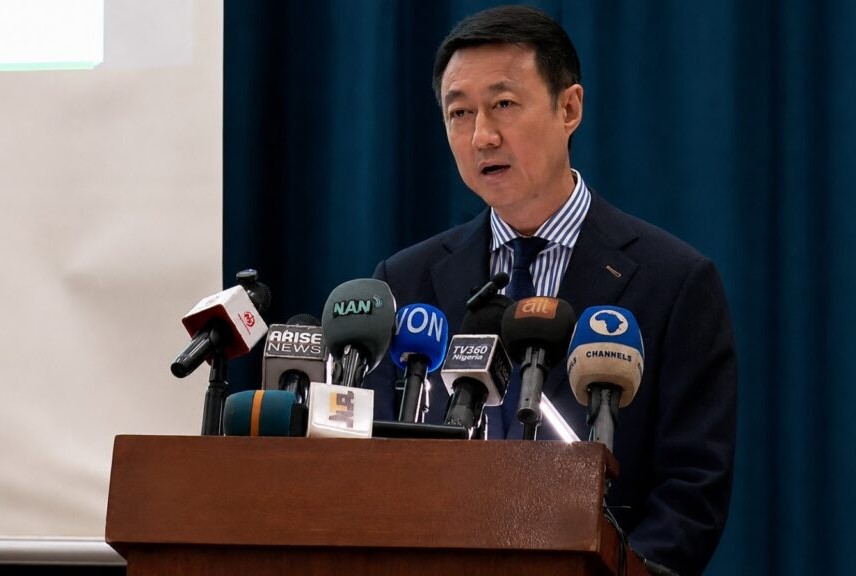
Chinese Ambassador to Nigeria Yu Dunhai said on Friday that Beijing’s imports from Nigeria surged 80 percent to $2.3 billion in the first half of 2026, driven by a zero-tariff policy that took effect on May 1 and covers all 53 African nations with diplomatic ties to China.
Speaking at an international seminar in Abuja organised by the Centre for China Studies, Yu said bilateral Trade between Nigeria and China reached $18 billion during the same period, a 35 percent year-on-year increase. Monthly import growth exceeded 40 percent in both May and June, he added, underscoring the policy’s immediate impact.
The envoy said the measure had already contributed to an estimated six percent rise in overall African exports to China. China-Africa trade hit a historic $207 billion in the first six months of the year, with Chinese imports from the continent climbing to $29 billion in May and June alone, up 24 percent year-on-year.
Yu cited concrete cost savings for Nigerian exporters. Every 100 tonnes of sesame shipped now saves $11,000 in tariffs, while Nigeria’s annual export of 7,000 tonnes of cattle bone granules avoids nearly $450,000 in duties. A single 23,000-tonne shipment of liquefied propane benefited from roughly $300,000 in tax relief.
The ambassador cautioned, however, that tariff elimination alone would not transform Nigeria’s Economy. He stressed the need for improved product quality, reliable supply chains and local processing, urging Nigerian businesses to invest in value addition and meet Chinese market standards to sustain access to the country’s 1.4 billion consumers.
Yu called for deeper cooperation on industrial parks, technology transfer and training, and said Beijing was ready to support Nigeria’s efforts to process raw materials domestically. China also aims to accelerate negotiations on trade facilitation, investment protection and quarantine standards to provide a stable institutional environment for investors.
He encouraged Nigerian exporters and small enterprises to leverage platforms such as the China International Import Expo, the Canton Fair and the China-Africa Economic and Trade Expo to connect directly with Chinese buyers.
Minister of Foreign Affairs Bianca Ojukwu, represented by Permanent Secretary Dunoma Ahmed, said the zero-tariff policy offered an opportunity to shift Nigeria from raw-material exports to value-added production. “The objective should be to ensure that a greater proportion of the value generated from Africa’s resources remain within Africa,” she said.
Minister of State for Agriculture and Food Security Aliyu Abdullahi echoed the call for quality over volume. “The question before us is not, can Nigeria export more? The question should be, can Nigeria export better?” he said, highlighting processed cassava, premium rice, spices, hibiscus, cashew and soybean products, fruits and vegetables as high-potential sectors. He added that tariff-free access must be matched by modern processing, efficient logistics, quality assurance, traceability, storage infrastructure and export certification.
Centre Director Charles Onunaiju said the seminar aimed to move discussions from policy announcements to practical implementation. He warned that African countries must develop strategies to fully exploit the new market access and noted the African Continental Free Trade Area could play a critical role by harmonising standards, strengthening regional value chains and creating economies of scale for exporters.
Onunaiju urged African nations to treat the zero-tariff policy as a starting point for deeper industrialisation rather than an end in itself. The event brought together government officials, farmers, manufacturers, exporters, traders and other stakeholders to identify practical solutions to barriers that could limit African Businesses from benefiting fully from the Chinese market.



![Osun election: Voters turn out early, wait for INEC officials [Video]](https://mediatalkafrica.com/wp-content/uploads/2026/08/Osun-voters-queue-early-for-governorship-election-as-INEC-materials-768x576.jpg)