
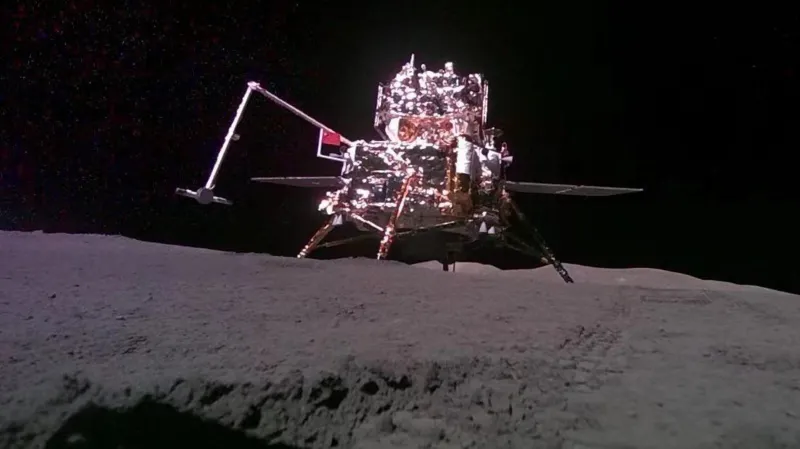
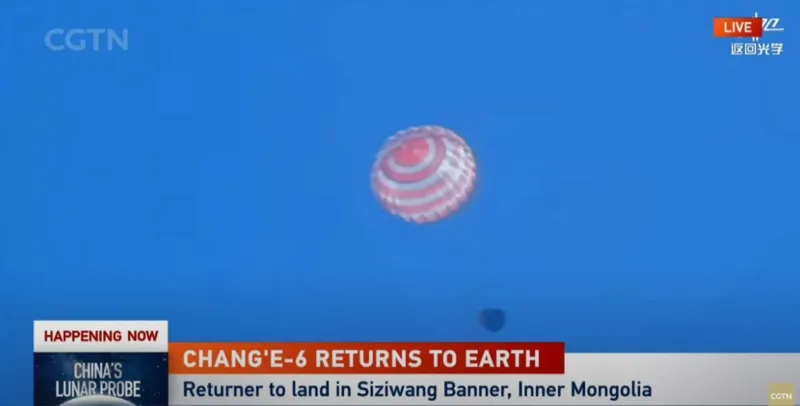
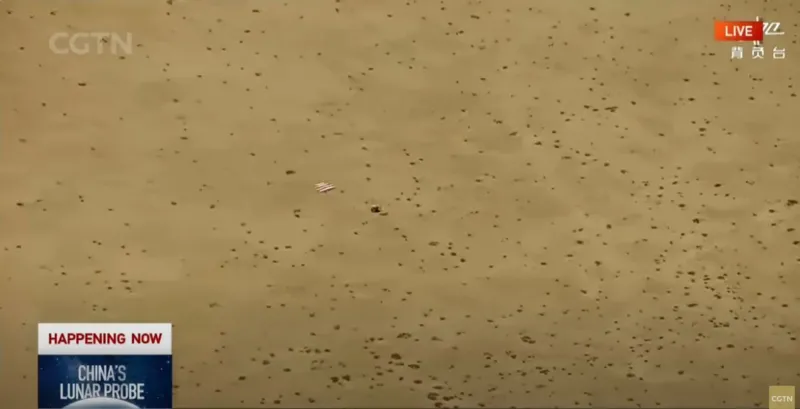
China’s lunar probe has returned to Earth with the first-ever samples from the Moon’s unexplored far side. The Chang’e-6 landed in the Inner Mongolia desert on Tuesday, after a nearly two-month-long mission fraught with risks. Scientists are eagerly awaiting the Chang’e-6 samples, which could answer key questions about how planets are formed.
China is the only country to have landed on the far side of the Moon, having done so before in 2019. The far side, which faces away from Earth, is technically challenging to reach due to its distance and difficult terrain of giant craters and few flat surfaces. Scientists are interested in this less-explored side as it is hoped it may contain traces of ice, which can be harvested for water, oxygen, and hydrogen.
The Chang’e-6 mission is a source of pride for a nation which has stepped up its missions to the moon, drawing attention from its rival, the US. State media showed officials planting the Chinese flag with a flourish just after the Chang’e-6 capsule landed in the desert of Inner Mongolia. China’s President Xi Jinping has called to congratulate those at the command centre of the Chang’e-6 mission. Mr Xi said he hopes they can carry on exploring deep space and “reaching new heights in unravelling the mysteries of the universe… to benefit humanity and advance the nation”.
This is China’s sixth mission to the Moon, and its second to the far side. The Chang’e-6 blasted off from a space centre in early May and successfully landed on a crater close to the Moon’s south pole a few weeks later. Its mission lasted 53 days. The probe will be sent to Beijing, and samples will be retrieved there, according to state broadcaster CCTV. The probe used a drill and a robotic arm to scoop up soil and rocks, take some photos of the surface, and planted a Chinese flag.
Beijing has poured huge resources into its space programme over the past decade in an effort to catch up to both the US and Russia. It aims to send a crewed mission to the Moon by 2030 and plans to eventually build a base on the lunar south pole. The US also plans to put astronauts back on the Moon by 2026 with its Artemis 3 mission. Analysts believe the next space race will not just be about putting people on the moon – it will be about who is able to stake their claim and control lunar resources.




Comments are closed for this story.