
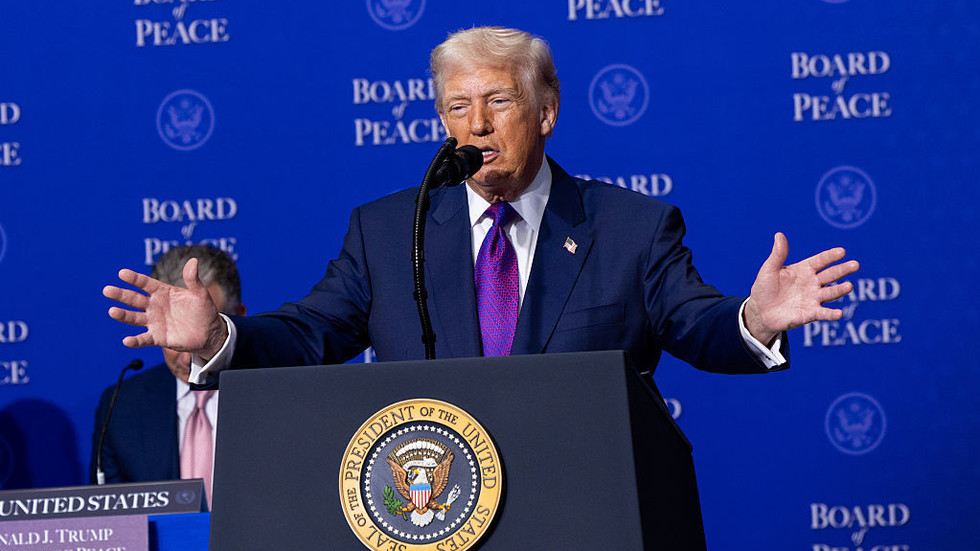
US President Donald Trump has launched a US-led “Board of Peace” to guide the reconstruction and stabilization of Gaza, a centerpiece of his peace roadmap. The board, formally established in mid-January, aims to coordinate international efforts and has already secured $5 billion in pledges for the territory’s rebuilding.
Approximately 26 countries have formally joined as founding members, including key Middle Eastern partners like Israel, the United Arab Emirates, Egypt, and Saudi Arabia. Hungary and Bulgaria are the only EU members to accept full membership, with Hungarian Prime Minister Viktor Orban attending the inaugural meeting in Washington. Several other nations, including India, Pakistan, Kazakhstan, and Indonesia, are participating, though many are represented by lower-ranking officials rather than heads of state.
Membership rules stipulate that a permanent seat beyond an initial three-year term requires a $1 billion contribution. The board’s charter grants its chairman, Trump, sweeping powers, including the authority to remove member states and appoint a successor. An executive board, including Trump’s son-in-law Jared Kushner and former British Prime Minister Tony Blair, will oversee operational planning.
The initiative has drawn significant criticism. Major Western powers, including France, Germany, the United Kingdom, and Spain, have declined full membership, citing concerns about the board’s mandate and potential overlap with the United Nations. The European Union is not joining, with Commission President Ursula von der Leyen declining to attend. The Vatican and New Zealand have also rejected participation, arguing that the Gaza response should remain under UN auspices.
A central point of contention is the complete absence of Palestinian political representation. Neither Hamas nor the Palestinian Authority (PA) were invited to join the board. Instead, a separate Palestinian-led committee for Gaza’s administration has been formed, with a proposed coordination committee to liaise with the Board of Peace. Palestinian officials and rights groups have condemned the plan as an effort to internationalize Israel’s occupation.
The board’s creation is widely seen as a challenge to the UN’s traditional role in mediating the Israeli-Palestinian conflict. The charter explicitly calls for the “courage to depart from approaches and institutions that have too often failed.” Trump has previously criticized the UN and announced US withdrawals from numerous international bodies. UN diplomats recently reaffirmed their crucial role in the conflict, convening separately to avoid clashing with the Washington meeting.
Russia has received an invitation and is studying the proposal. President Vladimir Putin indicated Moscow would consider joining, suggesting it might use $1 billion from frozen US assets to fund its participation, though no formal response has been given.
The board’s inaugural session sets a three-year timeline for its operations, contingent on sustained funding and membership. Its mandate includes delivering humanitarian aid, establishing security mechanisms, and creating a technocratic administration for Gaza. The success of this US-led coalition, and its relationship with existing international bodies, will be a critical factor in shaping the post-war future of the enclave and the broader regional diplomatic landscape.

Comments are closed for this story.