
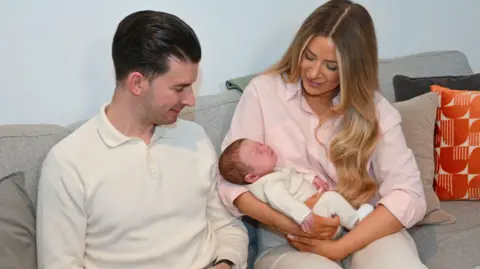
A baby boy has become the first in the United Kingdom to be born following a womb transplant from a deceased donor, a breakthrough in reproductive medicine. The child, named Hugo Richard, was delivered at Queen Charlotte’s and Chelsea Hospital in west London in late December 2025.
His mother, Grace Bell, 30, was born without a functioning womb due to Mayer-Rokitansky-Küster-Hauser (MRKH) syndrome, a condition affecting approximately one in 5,000 UK women. Despite having normal ovaries, she was told at age 16 she could not carry a pregnancy. The birth follows a 10-hour transplant surgery she underwent at The Churchill Hospital, Oxford, in June 2024, using an organ from a deceased donor. Subsequently, she conceived via in vitro fertilisation (IVF) at The Lister Fertility Clinic in London, with a successful embryo transfer leading to the pregnancy.
Bell described the moment as extraordinary. “It was simply a miracle,” she said, recalling the first sight of her son. Prof Richard Smith, clinical lead for Womb Transplant UK and the surgeon present at the birth, called it “an unbelievable journey” resulting from years of team collaboration.
The donor’s family expressed that the decision to donate provided “the precious gift of time, hope, healing and now life.” In a statement, the donor’s parents said they felt “tremendous pride” in their daughter’s legacy of “compassion, courage and love.”
While about 25-30 babies have been born globally from deceased donor womb transplants, most procedures use living donors. The UK’s first womb transplant, using a living donor, occurred in 2023. Crucially, womb donation requires specific family consent, as it is not covered under routine organ donor registration or deemed consent laws.
Medical teams plan to remove the transplanted womb once the family is complete, to prevent Ms. Bell from requiring lifelong immunosuppressant medication. This case demonstrates the expanding potential of deceased donor uterine transplants to address absolute uterine factor infertility, offering a new pathway for women with conditions like MRKH syndrome to experience pregnancy and childbirth. The procedure’s success is expected to influence future policy and clinical practice in reproductive medicine.



Comments are closed for this story.