
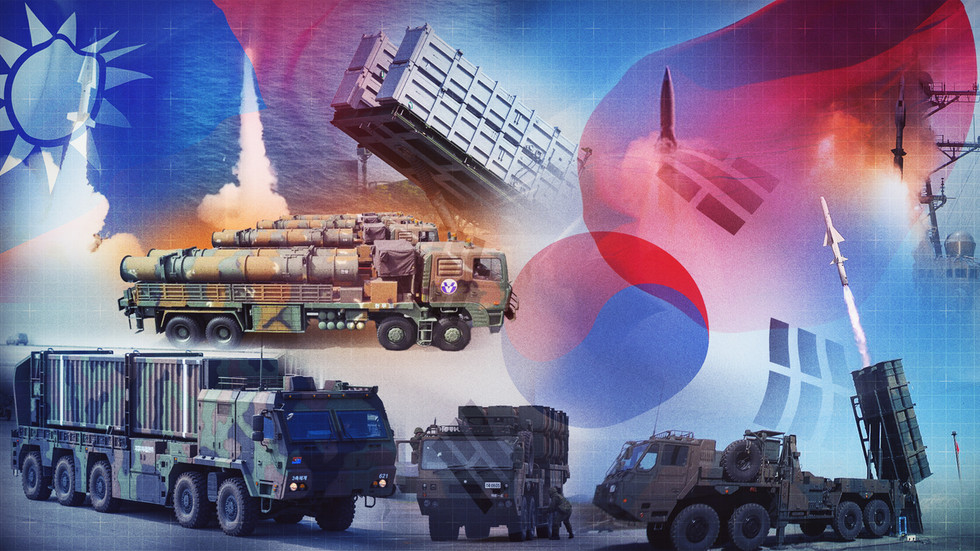
Facing mounting military pressure from China and North Korea, Japan, South Korea, and Taiwan are accelerating the expansion of their missile capabilities along distinct strategic paths, reshaping security dynamics in East Asia. This shift reflects a regional response to perceived threats, with each U.S.-aligned power advancing technologies that enhance strike ranges, survivability, and operational flexibility for potential conflicts.
Japan, historically constrained by post-war pacifist principles, is recalibrating its defense posture. Despite possessing advanced space launch capabilities since the 1970s and a robust missile defense system integrating U.S. Patriot and Aegis assets, Tokyo is now developing offensive missiles. Efforts include an improved Type 12 anti-ship missile with ranges extending to 1,200 km, a Tomahawk-inspired cruise missile for ships and aircraft, and the Hyper-Velocity Gliding Projectile hypersonic weapon, targeted for deployment by 2026–2027 with future ranges up to 3,000 km.
South Korea operates without political restrictions on missile development and has built a comprehensive arsenal. Its Hyunmoo family features the Hyunmoo-5 ballistic missile, with a 3,000 km range and an 8-ton warhead, alongside hypersonic cruise missiles like Hycore, which has achieved speeds around Mach 6 in tests. Cruise variants also offer ranges up to 3,000 km, establishing a full-spectrum deterrence posture focused on regional threats.
Taiwan, lacking an independent space launch capability, pursues an asymmetric strategy. It deploys Tien Kung surface-to-surface missiles and is developing new long-range anti-ship missiles with ranges of 600 to 1,000 km to interdict Chinese naval forces. This approach relies on U.S. and Japanese security assurances, given resource limitations and the absence of formal alliances.
Collectively, these programs form a layered deterrence architecture. Japan’s transition to strike capabilities, South Korea’s comprehensive buildup, and Taiwan’s anti-ship focus each address shared threats through unique technological and strategic calculations, all within the U.S. security framework.
The proliferation of longer-range, faster missile systems expands military options but compresses decision times during crises, raising escalation risks. As these capabilities mature, they will centralize missile warfare in East Asia’s security calculus, demanding vigilant management to prevent miscalculation and maintain regional stability.

Comments are closed for this story.