
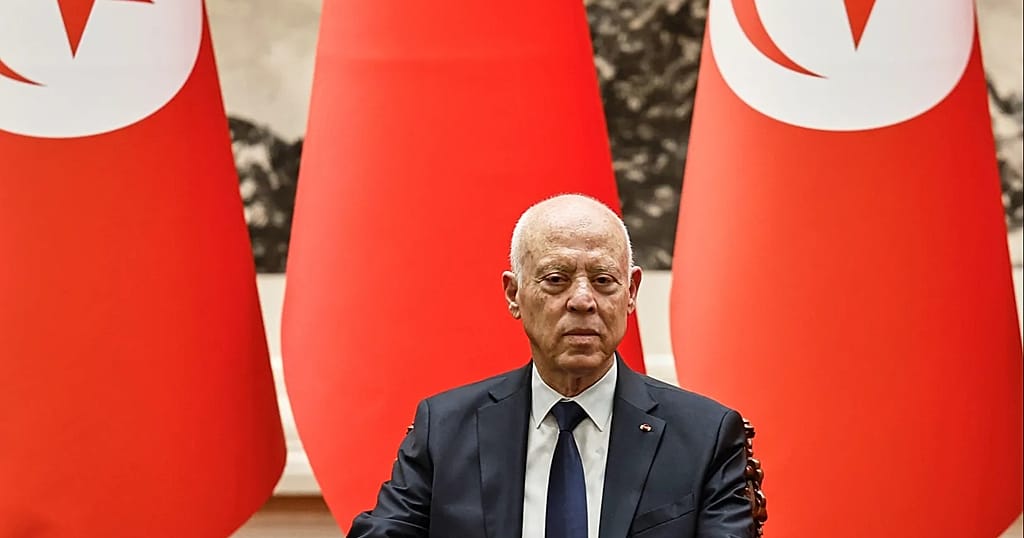
Tunisian President Kais Saied dismissed Energy and Industry Minister Fatma Thabet Chiboub on Tuesday, a move announced in a brief presidential statement that offered no justification. The decision comes as the parliament prepares to debate a set of draft laws governing renewable‑energy contracts that have sparked fierce opposition from trade unions and several lawmakers.
The proposed legislation would allow foreign companies that install solar‑panel farms to sell the electricity they generate to the state utility STEG for a 20‑year period, with a possible renewal of ten additional years. Under the draft, the first five years of operation would be tax‑free, after which the firms would be subject to standard fiscal obligations. The government argues that the measures will bolster Tunisia’s energy independence, secure supply and lower electricity production costs.
Tunisia today relies heavily on imported fuel, electricity and gas, a dependence that strains the national budget because of subsidies. According to State Secretary for Energy Transition Wael Chouchane, renewable sources accounted for 9 % of the grid in April, and the authorities target 35 % by 2030. In line with that goal, the government recently unveiled investment projects worth nearly $600 million to install solar capacity of 600 MW – roughly one‑quarter of the country’s annual consumption – in marginalised, high‑sunshine regions of the centre and south.
The draft bills, however, have been condemned by the UGTT, Tunisia’s powerful trade union federation, which described them as “perpetuating dependence on foreign countries and weakening national sovereignty.” The union called for “fair and equitable partnerships” between STEG and foreign investors. MP Bilel El Mechri, who has warned of “energy colonisation,” welcomed the minister’s removal and urged that she be “tried for compromising national sovereignty.”
In the interim, Housing Minister Salah Eddine Zouari has been assigned the responsibilities of the dismissed minister, the presidency said. The reassignment ensures continuity of the renewable‑energy agenda while the parliamentary committee reviews the contentious proposals.
The dismissal underscores the political sensitivity surrounding Tunisia’s energy transition. As the country seeks to diversify its energy mix and reduce import costs, the balance between attracting foreign investment and safeguarding national control remains a pivotal issue. The upcoming parliamentary session will determine whether the draft laws are amended, approved or delayed, a decision that will shape the pace and structure of Tunisia’s renewable‑energy rollout in the years ahead.



Comments are closed for this story.