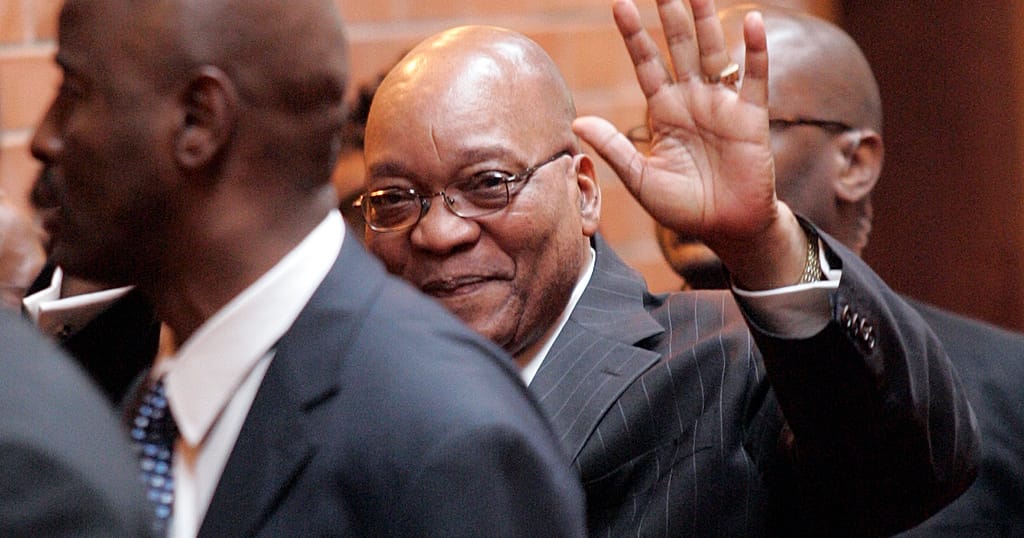
Just hours after a KwaZulu‑Natal High Court judge affirmed that the long‑running graft trial of former President Jacob Zuma must proceed, Zuma instructed his lawyers to lodge an appeal.
On Thursday the court ordered that the corruption case linked to the 1999 arms deal – in which Zuma and French defence contractor Thales are accused of fraud, money‑laundering and racketeering – will go ahead on 1 February 2027. Judge Nkosinathi Chili described the defendants’ tactic of filing repeated appeals as a “Stalingrad defence”, aimed at delaying the proceedings, and ruled that the “interests of justice” required the trial to move forward. He warned that without the court’s intervention there was a risk of “grave injustice” and damage to the administration of justice.
Zuma, 84, was not present for the judgment. He and Thales deny any wrongdoing. The case concerns alleged bribes of roughly $250 000 paid to Zuma, then deputy president, in exchange for shielding the company from investigation into a $2 billion procurement programme that included fighter jets, patrol boats and other military equipment from five European firms.
The pair previously sought to have criminal charges dismissed, an application that was rejected by the same judge earlier this year. Their numerous challenges and appeals have prolonged the litigation for more than two decades.
In a statement released on Thursday, the Jacob Zuma Foundation called the ruling “totally erroneous” and accused the court of “gross misdirection” on both factual and legal grounds.
Zuma led South Africa from 2009 until his forced resignation in 2018 amid a series of corruption scandals that engulfed the ruling African National Congress. He also faces separate accusations of facilitating the looting of state assets during his tenure. In 2021, Zuma was sentenced to 15 months in prison for refusing to testify before a commission investigating corruption and cronyism under his administration; he was released on medical parole after two months. The jailing triggered widespread unrest that resulted in more than 350 deaths, marking the country’s deadliest episode of violence since the 1994 democratic transition.
The upcoming trial will be the most significant test yet of South Africa’s ability to hold senior officials accountable for high‑level corruption. Observers note that the case’s delay, now extending to 2027, underscores the challenges of prosecuting complex, decades‑old financial crimes in a jurisdiction where political influence can impede judicial processes.
Legal analysts expect the appeal to focus on procedural arguments rather than the substantive evidence of wrongdoing. Regardless of the outcome, the case highlights ongoing tensions between the judiciary and political elites, and it may shape public confidence in South Africa’s anti‑corruption agenda.
The court’s decision is expected to be final unless the appeal succeeds, after which the trial is set to commence in early 2027. All eyes will be on how swiftly the judiciary can transition from procedural rulings to the substantive hearing of the charges against Zuma and Thales.