
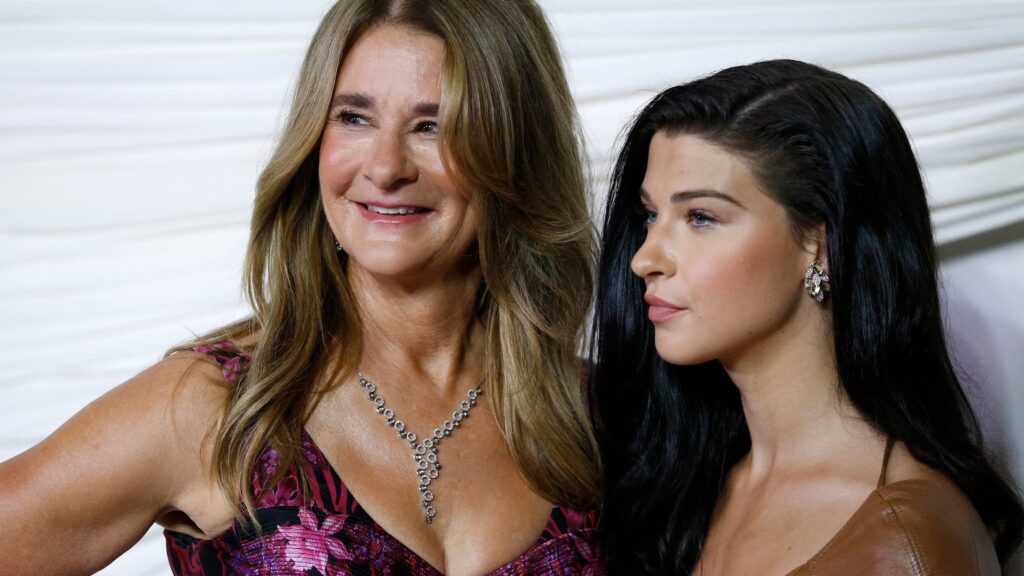
Melinda French Gates has learned a hard truth: when men fail to act, the world turns to women for solutions. She’s had plenty of those moments. Over the past two years, the philanthropist and author has funneled more than $400 million into women’s health, championing access to contraceptives and abortion rights. Now, she’s writing another check—$215 million—this time targeting a long-overlooked frontier: menopause. It’s her first major investment in midlife women.
“I’m both using my voice here and my money to say this is incredibly important,” French Gates told USA TODAY. “We ought to be pouring a lot more money into this area so that women can thrive and step into their full power.”
At 61, French Gates has been a relentless advocate for women. She spent 24 years at the Gates Foundation, co-founded with her ex-husband Bill Gates, overseeing billions in global health funding—maternal care, health inequities, you name it. Their 2021 divorce, while private, reportedly left her with a multi-billion-dollar fund for her philanthropy. She left the foundation in 2024 to launch Pivotal, her own venture.
Her focus sharpened after the Supreme Court’s Dobbs decision overturned Roe v. Wade. She pledged $1 billion to help women and families. “For too long, a lack of money has forced organizations fighting for women’s rights into a defensive posture while the enemies of progress play offense,” she said then. “I want to help even the match.”
This latest donation is personal. It’s drawn from what she’s seen on the ground—from women’s clinics in Tuscaloosa, Alabama, to schools in Malawi—and from her own life. Whether she’s walking with friends in Seattle or on a ski trip where “one of the women had to literally leave the table because she had a hot flash,” menopause is a constant topic.
Some of her friends visited multiple doctors before getting treatment. One survey found that one in five women waits a year for a menopause diagnosis; another showed 5% of women seeking help saw 11 doctors before finding relief. French Gates counts herself lucky. Her three closest friends are a few years older. “As they started to face this journey, they would be sharing with me what they knew, what they didn’t know, the misinformation,” she says.
Even with her privilege—top-tier health care, easy access to estrogen patches—her own physician was late to prescribe hormone therapy. “We are way behind what we ought to know about this phase of life for women. We’re way behind on knowing exactly how the hormones change and at what time. We’re way behind on sharing information with women,” she says.
She started paying it forward to younger women in her book club. “I was like, these are things you need to know. And I started to realize that we are trying to inform one another as women,” French Gates says. “There’s just so much more we can do here to make sure everybody’s trained properly, but also that we get the right information out.”
The investment kicks off with $10 million to the Menopause Society to train providers—from gynecologists to family physicians. It will also support contraception access, menopause care training, and research into conditions that disproportionately affect women. Most doctors, even gynecologists, lack adequate menopause training in medical school. Less than one-third of obstetrics and gynecology residency program directors reported receiving training themselves.
“We still have so many more women to reach, and this is going to go a long way to help,” says Dr. Stephanie Faubion, medical director of the Menopause Society and director of the Mayo Clinic Center for Women’s Health. She notes that only about two-thirds of menopause-certified providers accept insurance. “For too long, this stage of life—this perimenopause and menopause phase—was honestly invisible,” French Gates adds. “It was like a woman was just expected to deal with it behind the scenes.”
Whether grappling with maternal depression or seeking menopause treatment, women shouldn’t have to go it alone, French Gates insists. “Women’s health for too long has been underprioritized and underfunded,” she says. For every dollar spent globally on health research and innovation, just five cents goes to women’s health. “We need to change that because we know that when we do make the right investments in women’s health, then women can thrive. Man is the default in medicine, right? That’s where the research has been done.”
The burden shifts to women—a pattern she’s seen throughout her career. It resurfaced earlier this year when her ex-husband’s name appeared in files linked to convicted sex trafficker Jeffrey Epstein. Media outlets pressed her for answers. “Whatever questions remain there of what I don’t—can’t even begin to know all of it—those questions are for those people and for even my ex-husband. They need to answer to those things, not me,” she told NPR’s “Wild Card” podcast in February.
Women and victims, many of whom were girls when they first reported abuse, shouldn’t carry the load alone, she says. “Sometimes on these societal issues we’re using the women by default to either answer or to solve a problem. I think we need to rethink that as a society and say, ‘You know, who’s responsible for which pieces?’ How do we change these norms?”
French Gates sees righting the balance in health care as key to supporting women leaders. With one in 10 women leaving the workforce due to menopause, and another one in five considering early retirement, it chips away at female leadership—women already hold fewer than one-third of top jobs. “They are at the prime of their career. Just when the woman’s about to step into the CFO role, or step into the CEO or president role, like she has all this training and knowledge and experience,” she says. “I think we want that put into the workforce, not taken out. You have to be healthy to be able to do well at your job or at home.”
French Gates sees hope for women in their 50s and 60s. “They’re just incredibly enriching years. And I feel lucky to be alive and thriving at this age,” she says. “They have been some of the most satisfying and productive years of my life. You know, I feel like my youngest says, ‘Gosh, Mom is living her best life now.’”



Comments are closed for this story.