
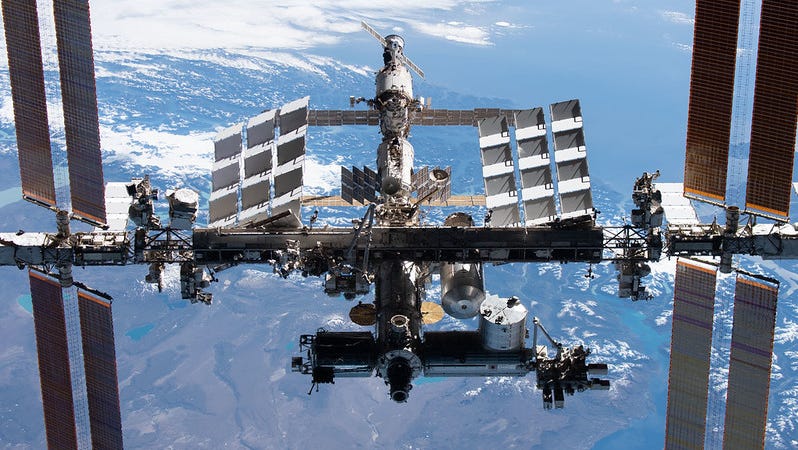
A routine day aboard the International Space Station turned into a high-alert operation this week when NASA ordered three American astronauts and one French colleague to take emergency shelter inside a docked SpaceX Dragon capsule. The directive came as Russian cosmonauts scrambled to repair a persistent air leak in the station’s aging Zvezda service module, a problem that has plagued the orbital outpost for years.
The decision, described by NASA spokeswoman Bethany Stevens as a precautionary measure, underscores the growing challenges of maintaining the 25-year-old laboratory. In a post on social media platform X, Stevens confirmed that Russian crew members were conducting “extensive” repairs on the transfer tunnel of the Zvezda module, the section most affected by a series of cracks that have emerged in recent years.
While NASA has made piecemeal efforts to patch the holes, Stevens acknowledged that a more permanent solution remains elusive. “We continue to work with our Russian counterparts, along with the rest of the international community that supports the space station, to arrive at a more permanent resolution,” she wrote.
The four astronauts taking shelter are part of Expedition 74, which includes seven crew members total. The group includes NASA astronauts Jessica Meir and Jack Hathaway, European Space Agency astronaut Sophie Adenot, and Russian cosmonaut Andrey Fedyaev, who arrived in February as part of the Crew-12 mission. They are scheduled to depart in September when Crew-13 arrives. Also aboard are NASA astronaut Chris Williams and Russian cosmonauts Sergey Mikaev and Sergey Kud-Sverchkov, who arrived in November and will remain until their replacements arrive in July.
The ISS, orbiting roughly 260 miles above Earth, has been a continuous home for astronauts from around the world for more than 25 years. It has served as a vital research platform for microgravity science and has hosted private commercial missions in recent years. The station is operated through a partnership of space agencies including NASA, Roscosmos, the European Space Agency, the Japan Aerospace Exploration Agency, and the Canadian Space Agency. To date, more than 290 spacefarers from 26 countries have visited the station, including 170 from the United States.



Comments are closed for this story.