
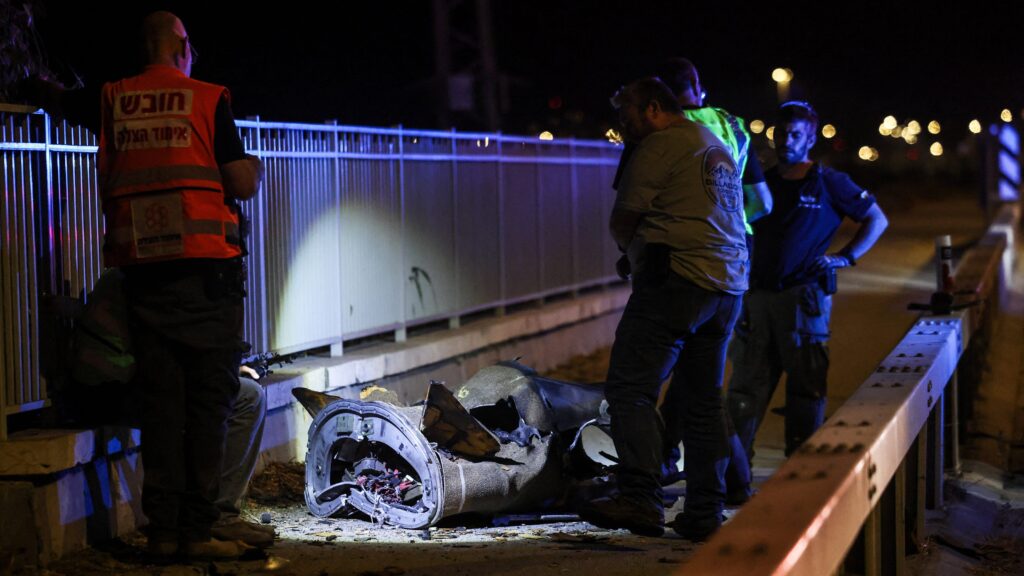
The night sky over Tehran, Tabriz, and Isfahan lit up with explosions as the Israeli military launched strikes deep into Iran early on June 8. The attack came just hours after Iran fired ballistic missiles at northern Israel, marking the first direct military exchange between the two nations since a fragile ceasefire took effect in early April.
Local media reported multiple blasts across the Iranian cities. The Israeli Defense Forces confirmed the strikes targeted military installations in western and central Iran. This retaliation followed a volley of Iranian ballistic missiles aimed at the Ramat David Airbase in northern Israel, a move claimed by the Islamic Revolutionary Guard Corps.
The IDF stated its defensive systems intercepted several incoming missiles, triggering sirens across affected areas. The IRGC warned that if Israel continued its operations in Lebanon, it would face “more crushing and regretful blows.” The group’s top joint military command declared, “We had previously warned that if the crimes in the Dahieh area of Beirut expand, we will attack targets in the occupied territories.”
The escalation began after Israel struck the outskirts of Beirut on June 7, targeting a Hezbollah stronghold in the Dahieh district. Prime Minister Benjamin Netanyahu said the strike was ordered in response to Hezbollah fire. President Donald Trump, briefed on the spiraling conflict, criticized Israel’s Beirut strike, telling Fox News he was “not happy about it.” He also told Axios he planned to call Netanyahu and urge him not to retaliate against Iran.
“Iran had its strike. Israel had its strike. We don’t need another one,” Trump said, according to Axios. “We are very close to a final deal with Iran. It is going to be a good deal. I don’t want it to blow up because of what is happening now.”
Hours after the Iranian attack, an Israeli military statement from Chief of Staff Eyal Zamir said the IDF had not yet been ordered to strike Iran but would do so “with determination” once given the green light. Trump, in an interview with The Financial Times, asserted that Netanyahu “doesn’t call the shots” and would have no choice but to accept any U.S.-Iran deal. “I call the shots. I call all the shots,” Trump said.
The conflict threatens to unravel a ceasefire brokered in April, which had halted direct Iran-Israel strikes but did not stop Hezbollah attacks from Lebanon. Tensions have simmered for weeks, with both sides launching repeated strikes. Iran’s parliamentary speaker, Mohammad Bagher Ghalibaf, signaled potential further escalation, calling U.S. bases and Israeli assets legitimate targets.
The U.S. military has also been active, striking Iranian coastal radar sites in the Strait of Hormuz on June 6 after shooting down Iranian drones. The IRGC claimed retaliation against U.S. bases in Kuwait and Bahrain, with Kuwait’s army reporting seven ballistic missiles passed over residential areas, causing material damage but no casualties.
Amid the chaos, Trump spoke with Netanyahu for less than half an hour, according to an Israeli official. Trump later told Fox News that Iran needs to “get back to the table and make a deal,” adding that the missile attack “certainly not going to help negotiations.” He claimed an agreement could be signed “Monday, Tuesday, or Wednesday.”
But the violence shows no sign of abating. Iran suspended flights at Imam Khomeini International Airport, while Syria and Iraq announced temporary airspace closures. The U.S. Embassy in Jerusalem ordered all employees and their families in Israel to shelter in place. The question now is whether diplomacy can survive the night.




Comments are closed for this story.