
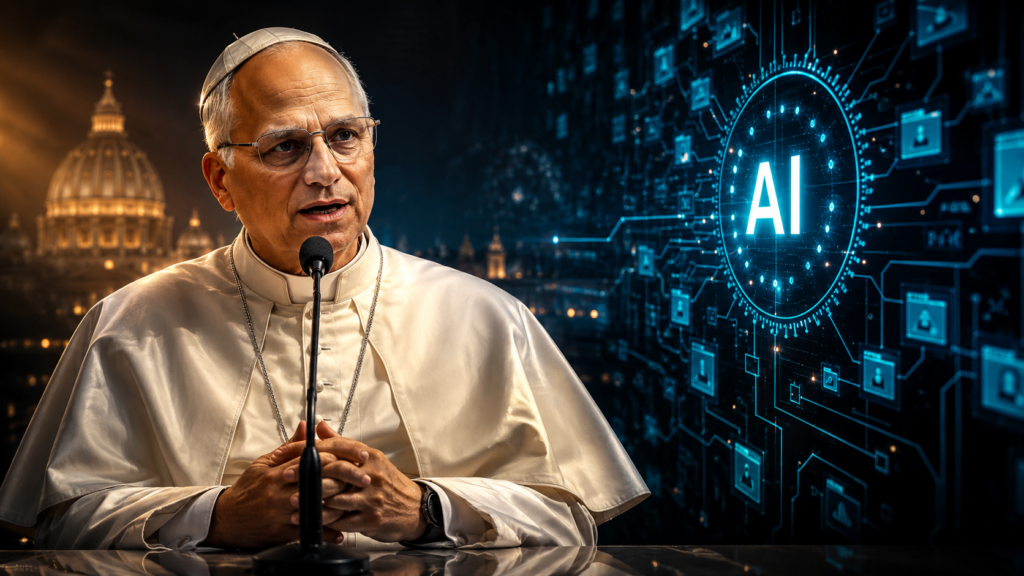
Artificial Intelligence has evolved from a corporate experiment into a force reshaping human existence. It restructures industries, slashes jobs, and boosts efficiency to unprecedented levels. Its impact on healthcare, education, and transportation—like self-driving cars—is undeniable. But beneath the promise lies a darker truth: AI threatens human survival itself.
Pope Leo XIV addressed this head-on in his May 25 encyclical, “Magnifica Humanitas: On Safeguarding the Human Person in the Age of Artificial Intelligence.” He stressed the right to work, security, and respect for others’ rights. His core message: AI must be “disarmed.”
At the launch, AI experts like Christopher Olah of Anthropic agreed. “The questions raised by AI are bigger than the research community,” he said. The Pope warned that less human control over AI weapons fuels endless wars. Russia’s conflict with Ukraine proves it: In October 2025, Russia launched over 4,000 drones, with Ukraine facing 256 projectiles daily.
The economic toll is staggering. Amazon cut 16,000 jobs in January. Cloud Fare announced 96,000 layoffs in May—20% of its workforce. Creative industries suffer too. Artists and filmmakers sue over AI-generated fakes that steal their work. Students at universities across the globe fear their degrees won’t guarantee jobs, booing speakers who urge them to adapt.
AI pioneers have long urged caution. In 2023, researchers like Yoshua Bengio, Stuart Russell, Steve Wozniak, and Elon Musk called for a pause until safety protocols are in place. Geoffrey Hinton, the “Godfather of AI,” warned that super-intelligent machines could harm humanity. Joep Meindertsma of Pause AI demands a global treaty: “We need to think about the kind of society we want.”
Over 70 NGOs, the Red Cross, and the UN Secretary-General condemn weapons lacking human oversight. Yet extremists argue a pause is futile, claiming AI can spread itself, manipulate people, and invent new weapons.
But scrapping AI entirely is reckless. The World Economic Forum predicts AI will create 170 million jobs by 2030, displacing 92 million. It already enables miracles, like a surgeon in China performing prostate surgery from 220 kilometers away using robotic arms.
The choice is ours: a society that embraces AI with ethical safeguards, or one that descends into chaos. Pope Leo’s call reminds us to prioritize humanity. The global community must rally for regulation that empowers, not endangers, us all.


Comments are closed for this story.