
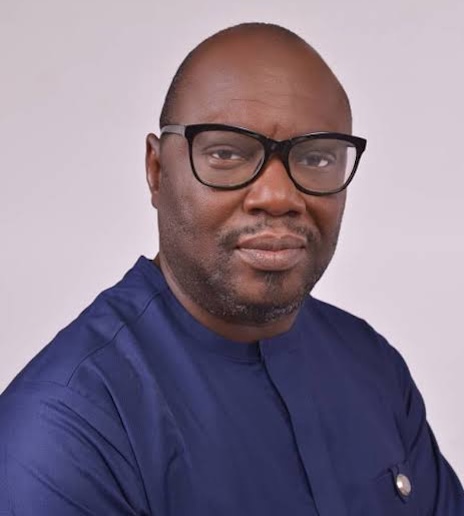
On Friday morning, an email from SSOAR, the German social science repository, confirmed what had already become an extraordinary week. Within seventy-two hours, a 16,315-word theoretical treatise titled “The Trinity of State Decay (Part 1): Sovereign Decoupling and Rival Sovereignty — A Theoretical Statement” had been accepted and archived by Zenodo, the CERN-backed open-access platform; Harvard Dataverse, operated by Harvard University; and now SSOAR, run by GESIS, the Leibniz Institute for the Social Sciences. The author, Max Amuchie, a Nigerian journalist and media CEO, had not planned this. But the symmetry was impossible to ignore. Three months since his column The Sunday Stew launched. A trilogy of original contributions: The Insecurity Triad, a security analysis framework; the Trinity of State Decay, a theoretical formulation; and the Decoupling Sovereignty Index, a quantitative metric. And now a triple publication in a single week. His work now lives across seven institutional repositories, including SSRN, SocArXiv, ResearchGate, and Academia.edu.
Amuchie did not set out to become a theorist. The seed was planted years ago, by accident, in the history section of the University of Calabar library. He was researching Nigerian history for a term paper when a book spine caught his eye: a biography of Sigmund Freud. He borrowed it, read it in a week, and one idea lodged itself in his mind. Freud defined immortality not as a mystical phenomenon, but as being known by many anonymous people. It was the act of leaving an intellectual footprint so distinct that your ideas are absorbed by millions who may never meet you, but who must use your language to understand their own reality. Freud changed the global vocabulary. People who have never read a page of psychoanalysis use words like ego, subconscious, and projection every day. They operate within his architecture without knowing it.
Later, in Lagos, a mentor named C.Don Adinuba handed Amuchie a book by Edward Said and told him to read it. Said’s “Representations of the Intellectual,” drawn from his BBC Reith Lectures, argued that the intellectual’s vocation is to speak truth to power, represent the unrepresented, and refuse the comfort of specialization. From Said, Amuchie discovered Antonio Gramsci, who argued that intellectual activity exists wherever people help shape ideas and influence how society understands itself. For Amuchie, this reframed journalism not as a mere profession of reporting events, but as an inherently intellectual vocation. The journalist occupies a vital bridge between structured knowledge and public life.
The question that started everything was simple: Why does Nigeria keep bleeding? Why do the same communities bury the same dead in the same circumstances, decade after decade, while the state issues predictable condemnations and commissions redundant reports? The honest pursuit of that question eventually produced what the academy calls a macro-theoretical framework. The Trinity of State Decay did not arrive fully formed. It emerged from frustration with imported analytical frameworks that failed to explain the reality in front of his eyes. Failed state theory describes a static outcome. It names the corpse but fails to trace the cause of death. The Fragile States Index produces rankings but isolates no mechanisms. What was missing was an indigenous framework that could explain the structural logic by which sovereign authority fractures and is progressively displaced by rival formations.
The insight was disarmingly simple: states do not lose control randomly. They lose it systematically along three specific axes: Money, Land, and Mind. When the state loses command of fiscal and economic legitimacy, territorial authority over its physical space, and ideological and psychological hold over the population, something else moves in. Not chaos. Something far worse: a disciplined, purposeful Shadow Order, often more efficient at enforcement than the formal state it displaces. This is what the Trinity of State Decay theorizes. Not the mere failure of the state, but the active production of an alternative to it.
The geography of legitimate knowledge production has long maintained a centre and a periphery. The global centre produces the theoretical frameworks; the periphery receives them and applies them submissively. What is happening now with the Sundiata Post Intelligence Unit is a demonstration that intellectual rigour does not possess a postal address. The publication of the Trinity of State Decay on global scholarly platforms is not an end point. It is the formal opening of a conversation three decades in the making. If a professor at Harvard, a post-doctoral fellow in Legon, a PhD candidate in Oxford, or an undergraduate in Makerere finds it useful and engages with it, the purpose will have been fulfilled. None of them may ever know Amuchie personally, just as he never knew Freud, Gramsci, or Said. Symmetry, he has come to understand, is not always visible at the beginning of a journey. It reveals itself exclusively in retrospect. Which is, incidentally, also how Sovereignty Decoupling becomes visible to those living through it.



Comments are closed for this story.