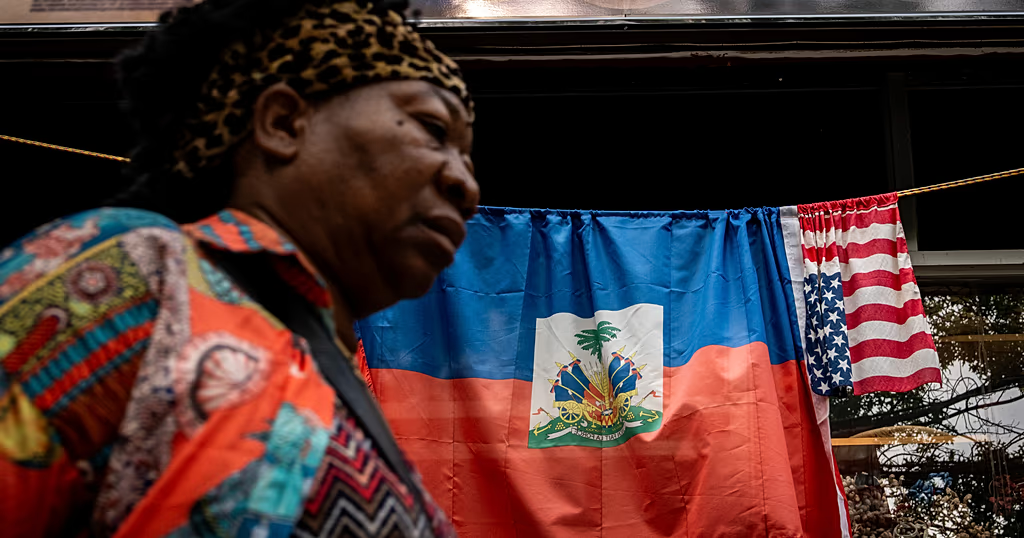
Last month the United States Supreme Court allowed the Trump administration to terminate Temporary Protected Status for Haitians and Syrians, a move that will affect thousands of migrants and could lead to widespread deportations. The decision comes at a time when the humanitarian crisis in Haiti remains dire, with violence and instability making return unsafe for many who have sought refuge in the United States.
In New Orleans, Haitian culture has been woven into the city’s fabric for more than two centuries. From the distinctive shotgun houses that line the streets to the ubiquitous dish of red beans and rice, Haitian immigrants have left a lasting imprint on Louisiana, and especially on the Treme neighborhood. The area was first settled by refugees fleeing the Haitian Revolution in the early 1800s, a history that still echoes in the neighborhood’s architecture and community life.
Chef and owner of the restaurant Fritai, Charly Pierre, says the city feels like a “beautifully dysfunctional” version of the Caribbean. “That reminds me of being in the Caribbean,” Pierre says. Raised in Cambridge, Massachusetts, Pierre’s parents fled Haiti to Venezuela before arriving in the United States in 1988. “They just wanted a new life. Just like most Haitians who leave Haiti, they wanted something a little bit more than what Haiti had to offer at the time,” he recalls.
Pierre’s restaurant sits on the edge of Treme, a place where the intertwining of Haitian and New Orleans cultures is visible every day. “If you just came from Haiti and just landed here and you knew nothing about the history of New Orleans and Haiti, you would just see the intertwining cultures and activities that happen on a daily basis,” he explains.
Tulane University professor Laura Adderley, who studies the city’s cultural dynamics, disagrees with the Supreme Court ruling. “I think it poses a national challenge to us as a city with an opportunity to stand up for the diverse immigrant character of our city and of the United States as being legitimate and to not be swept aside in the interests of some short‑term political concerns,” Adderley says.
Both Pierre and Adderley echo a shared concern for undocumented Haitians in New Orleans. Pierre notes that he encounters Haitian people sporadically and worries about their legal status. “All these people are humans and they’re just trying to live, make an earning to support their whole family just like everybody else,” he says.
The Supreme Court’s decision to allow the Trump administration to end TPS for Haitians and Syrians underscores a broader debate about immigration policy and the protection of vulnerable communities. As the city of New Orleans continues to celebrate its Haitian heritage, the legal and humanitarian implications of the ruling will remain a pressing issue for residents, scholars, and policymakers alike.