South Africa marked 70 years since the historic Women’s March of 1956 on Sunday, commemorating the day around 20,000 women of all races converged on the administrative capital, Pretoria, to protest apartheid laws that forced Black women to carry passes restricting their movement. The demonstration on August 9, 1956, stands as a pivotal moment in the struggle against white minority rule, but seven decades later, many women say the fight for freedom remains unfinished as the country grapples with persistent gender-based violence, poverty and inequality.
A United Nations Women-supported study published in 2024 found that more than one in three South African women have experienced physical or sexual violence in their lifetime. The UN has described the crisis as a “national wound.” Government data further shows women are more likely than men to be unemployed, bear the burden of unpaid care work and remain underrepresented in senior leadership positions.
Ramnie Dinat, 84, was a teenager when she helped her mother, anti-apartheid activist Ama Naidoo, organise women for the march. Black women, women of Indian heritage like Naidoo, and some white women marched together that day. “Everybody had to play a part. To organise it wasn’t easy. You had to go from door to door, knock at the door and tell the women, come out on the march. It’s very important,” Dinat recalled.
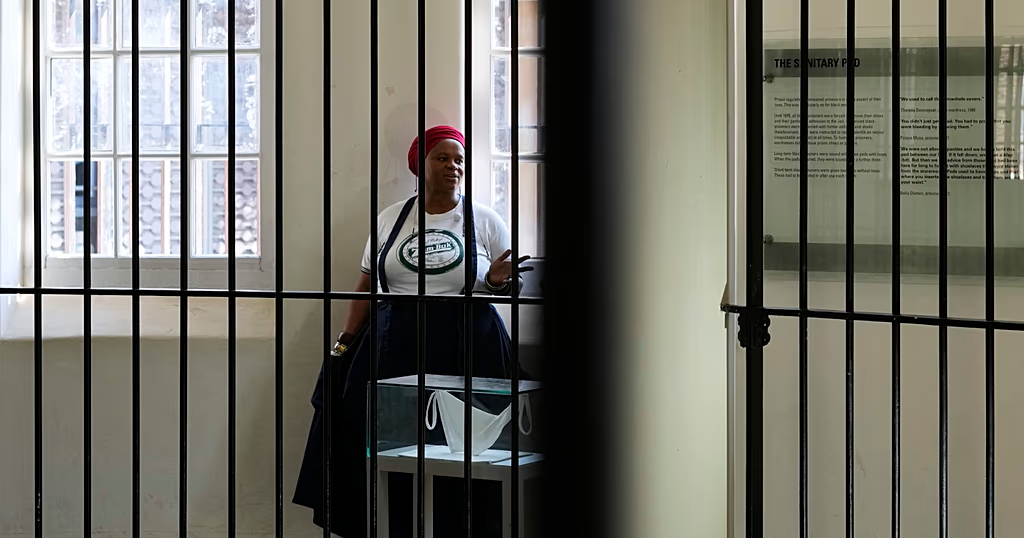
Many of the march’s leaders and participants were later imprisoned at the Women’s Jail on Constitution Hill in Johannesburg, a facility designed to enforce racial segregation even behind bars. Nolubabalo Memese, Visitors Services Manager at Constitution Hill, said the jail was designed to break, humiliate and dehumanise. Black women held there were not allowed to wear underwear or given proper sanitary towels. Today, the site operates as a museum near the Constitutional Court, honouring both prominent figures like Winnie Madikizela-Mandela and Albertina Sisulu and the thousands of ordinary women whose sacrifices went unrecorded.
Paralympic wheelchair tennis champion Kgothatso Montjane, 40, who won the 2024 Wimbledon wheelchair doubles title, said the 1956 march “paved the way for us.” She is the first Black South African woman to compete in all four major tennis tournaments. Yet Montjane noted structural inequalities persist in sport, where financial barriers still determine access to elite competition.
Memese said that while apartheid ended in 1994 and women are no longer legally restricted from moving or working, gender-based violence now acts as a different kind of barrier. “There’s a different monster which precludes us from enjoying freedom of movement and economic participation. And that’s gender-based violence. That’s crime,” she said. “If you want to go jog at six o’clock and it’s a bit dark, you’d rather not.”
When the old Women’s Jail was demolished, some of its bricks were reused to build the museum that now stands in its place — a physical reminder of the country’s journey from oppression to democracy. For Dinat, the lesson has not changed in 70 years. Every generation faces its own struggles, she said, and every generation must decide whether it will stand up for what is right.