The foundation for Kawira Mirero’s business was laid at age 17, when a mural commission for a nursery school in Mombasa earned her Sh4,500. The project confirmed her conviction that her future lay in arts, design, and working with people.
While a student at The Alliance Girls High School, a teacher organized a visit to the University of Nairobi where Mirero and her classmates interacted with design students and tutors. She would later enroll at the same university, majoring in design.
Though her academic background provided strong preparation, Mirero undertook a 17-year corporate career before launching Mambo Pambo, her Fashion line.
Light bulb moment
Living in Accra, Ghana, and Abuja, Nigeria, proved pivotal. There, Mirero witnessed a fully developed industry built around fashion.
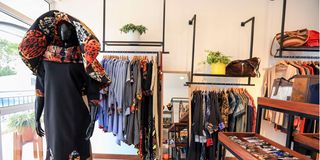
Mambo Pambo, a clothes retail shop at Nairobi’s Two Rivers Mall. FILE PHOTO | POOL
“My husband and I had moved to West Africa for work when I came face to face with the business aspect of fashion,” she says. “I saw people making money from it. I started building my business slowly by collecting fabric, designing outfits, and selling them.”
The transition from passion to business formalized in 2015, when the family returned to Kenya and Mirero officially set up operations from a guest room in her apartment.
She wanted the Kiswahili word Pambo (decoration/adornment) in the business name. Her children, then learning rhyming words, suggested Mambo, and the name was registered and the enterprise incorporated.
Asked what it takes to start a fashion line, she jokes: “A guest room in your apartment.” Seriously, she lists funding, vision, human resources, strong will, unwavering spirit, passion, and inventory as essentials.
Mirero returned to school for a Master’s degree to understand business beyond her creative passion, but emphasizes that capital remains the most critical requirement. She bootstrapped most of her initial investment.
Small beginnings
“I started the business from my savings—about Sh200,000 for a sewing machine, an overlock machine, threads, needles, and other garment construction essentials,” she recounts. “I had also put away half a shipping container of fabric from West Africa valued at about Sh200,000.”
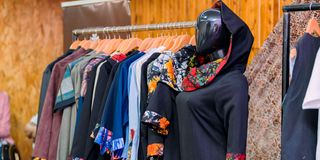
Mambo Pambo, a clothes retail shop at Nairobi’s Two Rivers Mall. FILE PHOTO | POOL
Collectively, the startup capital totaled roughly Sh400,000. “The money wasn’t enough to hire the space I wanted, so it was just me, two tailors, and the guestroom at the beginning,” she says.
She reinvests nearly all earnings and has secured additional facilities from HEVA (an East African fund investing in the creative sector) and local banks to scale operations.
“I put back almost all the money we earn into the business. We have also secured facilities from HEVA and local banks. The company’s track record of discharging our debt financing—sometimes early—and sustainably growing revenue year-on-year has created and maintained a credit-worthy profile for us,” she adds.
Running a micro-SME in fashion, Mirero admits, is a “daredevil act” in a saturated market. “At every turn in the country right now, there is a designer, a tailor, the whole ensemble.”
Her competitive edge lies in her team and her formal training. “I am a trained designer with academic and professional grounding in the principles of design and branding. I believe this adds an authentic stamp of approval on our work and creates a flywheel to keep generating new concepts and design ideas.”

Kawira Mirero, the founder of Mambo Pambo, a retail shop in Nairobi. PHOTO | POOL
Staying relevant demands constant creativity—seeking new designs, fabrics, and techniques to refresh her clients’ wardrobes.
Her design process follows three streams:
1. Inspiration: The “Power Collection,” for instance, originated from a man’s tie. The concept struck at 3 a.m. after months of searching for a unique angle. She begins with a brief: what to design, for whom, for what occasion, and whether it is sufficiently unique.
2. Client Input: Challenges from clients and fans often spark ideas. Three separate people questioned why she hadn’t incorporated Kikoi fabric. “It is the one fabric we can say is uniquely Kenyan,” she notes.
3. Iteration: She sketches initial concepts in pencil, typically producing 12 designs, selecting six for production, and advancing the remaining six to the prototype stage.
Future prospect
Mambo Pambo has since expanded from the apartment guest room to stores and workshops in Nairobi’s Kilimani, Karen, and Village Market.
Mambo Pambo location. FILE PHOTO | POOL