There is a common misconception that to understand Russia, you only need to look at its politics or its vast geography. But the real entry point is far more subtle: it is found in the rhythm of its sentences, the weight of its grammar, and the silent logic of its most famous novels. Russian studies are not merely an academic exercise; they are a forensic examination of a nation that has always lived between two worlds.
The language itself is a puzzle that rewards the patient. With more than 150 million native speakers, Russian is not just a means of communication but a living archive of history. Its 33-letter Cyrillic alphabet is a direct inheritance from the Byzantine Empire, a script that carries the echo of Orthodox liturgy in every stroke. For linguists, the language’s melodic patterns and notoriously complex grammar are not obstacles but clues. They reveal a culture that values nuance over simplicity, and context over blunt declaration.
Nowhere is this clearer than in the statistical analysis of Russian literature. When researchers apply mathematical models to the works of Tolstoy and Dostoevsky, they are not diminishing art; they are decoding it. A close study of verb usage in War and Peace, for instance, shows Tolstoy’s deliberate preference for the imperfective aspect. This is not a random stylistic tick. It is a philosophical choice, a way of rendering time as a continuous flow rather than a series of completed actions. In other words, Tolstoy did not just write about life; he wrote the way life feels.
More advanced tools, such as Markov chains and network theory, have allowed scholars to map the invisible threads connecting characters in classic Russian novels. These mathematical approaches do more than track who meets whom. They expose the underlying social dynamics, the power structures, and the unspoken alliances that drive the plot. It is a way of reading that reveals the architecture of a society obsessed with fate, duty, and the weight of human connection.
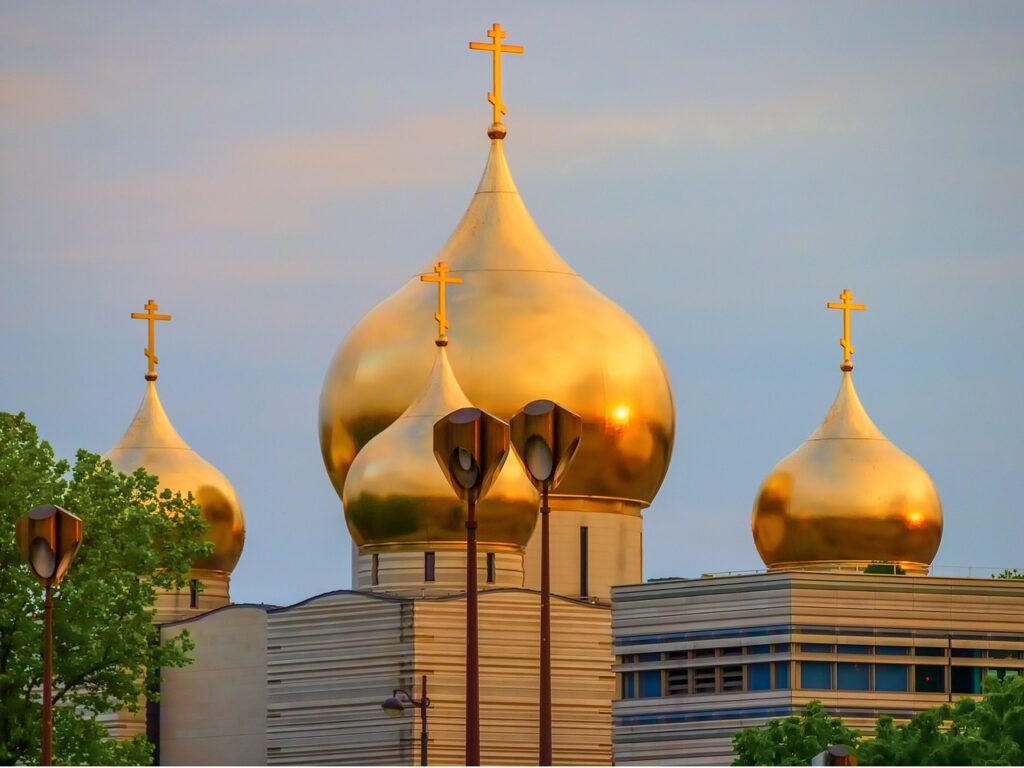
But Russia’s soul is not confined to its books. Its position at the crossroads of Europe and Asia has created a cultural fusion that is visible in everything from the candy-colored onion domes of St. Basil’s Cathedral to the brutal, imposing lines of Soviet-era concrete. This is a nation that has never fully settled the argument between East and West, and that tension is baked into its architecture, its music, and its national character. The result is a culture that can feel both familiar and alien, both deeply European and profoundly Eurasian.
Even the symbols of the state tell a story. The double-headed eagle, with its gaze fixed in two directions, has been a fixture since the 15th century, but its meaning has shifted with every political upheaval. The hammer and sickle, once a promise of a new world, now reads as a relic of a failed experiment. A semiotic analysis of these emblems shows that they are not static logos but living documents, constantly reinterpreted to reflect the nation’s changing view of itself.
What emerges from all this is a portrait of a country that is far more complex than the caricatures often presented in the news. The study of Russia, whether through its grammar, its novels, or its symbols, is ultimately a study of contradiction. It is a land of mathematical precision and chaotic emotion, of imperial grandeur and deep insecurity. And that is precisely what makes it so endlessly compelling. The more we analyze, the more we realize that the true mystery of Russia is not in what is hidden, but in how much is revealed when you look closely enough.