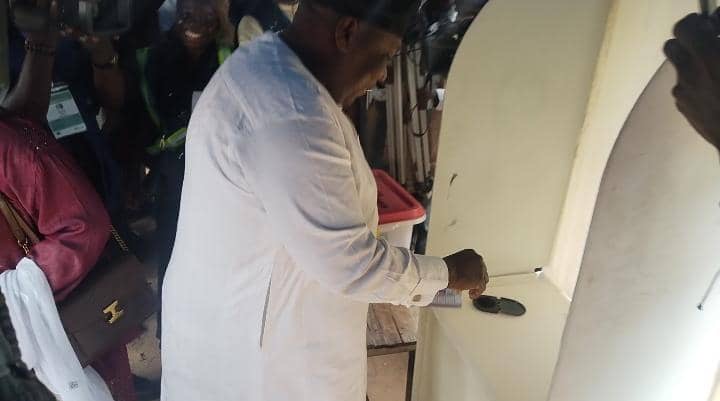
Voters at polling units in Ejigbo Local Government Area of Osun State have alleged that suspected supporters of the All Progressives Congress (APC) were distributing money during the ongoing governorship election, incidents captured on video and shared widely on social media.
The first reported incident occurred at approximately 9:30 a.m. at Ward 4, Unit 7, where voters confronted individuals accused of sharing cash. A second, similar allegation surfaced around 10:30 a.m. at Ward 4, Unit 13. In both instances, the accused individuals reportedly fled the scene with undisclosed amounts of money concealed in a polythene bag.
“We don’t know how much was there. They ran away and used a polythene bag to take the money away,” one voter stated in the video footage. The same voter added that electoral officials had instructed against monetary distribution at polling units. “The rule given to us was that we should not give money to anyone. We did not cause any trouble; we were only running after them.”
Some voters displayed currency notes they claimed to have recovered, alongside a card bearing the APC logo, which they presented as evidence linking the suspects to the party. “This is the evidence. The card they used belongs to the APC, and their logo is on it,” the voter said.
Notably, the alleged vote buying at Ward 4, Unit 7 took place at the polling unit of Najeem Folasayo Salaam, popularly known as Iwaloye, the African Democratic Congress (ADC) governorship candidate. Voters emphasized the political sensitivity of the location. “We are talking about Iwaloye, the ADC candidate. At his unit, APC members are sharing money. It happened at about 9:30 a.m. in Unit 7 and 10:30 a.m. in Unit 13,” one voter alleged.
The incidents have reignited concerns over electoral integrity in a state where vote buying has been a persistent challenge in previous election cycles. While security personnel are typically deployed to polling units to deter such activities, the rapid dispersal of the suspects before formal apprehension raises questions about enforcement capacity.
Osun State has a history of closely contested gubernatorial races, and allegations of financial inducement often accompany high-stakes polls. The Independent National Electoral Commission (INEC) and security agencies have yet to issue an official statement on the specific incidents in Ejigbo. However, the availability of video evidence may prompt investigations, as electoral offenses related to vote buying carry legal penalties under the Electoral Act.
As voting continues across the state, observers and party agents are monitoring compliance with electoral guidelines. The credibility of the process hinges not only on the conduct of voters and parties but also on the responsiveness of institutions tasked with safeguarding the ballot.