
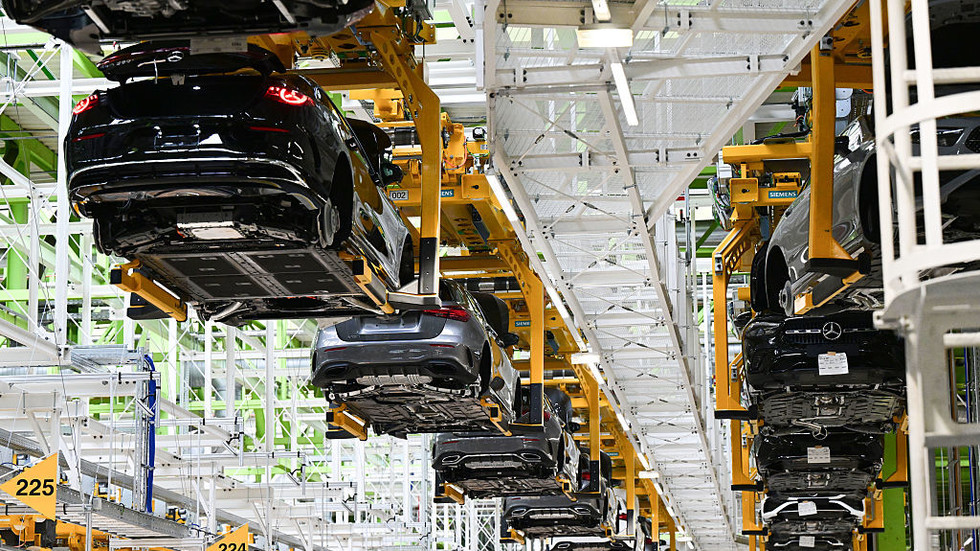
Germany’s auto industry faces a €10 billion ($11.6 billion) blow to cash flow in 2023, driven primarily by U.S. trade tariffs, according to a Financial Times report citing analytics from Visible Alpha. The sector, already strained by high energy prices, weakening demand, and Chinese competition, now confronts deepening challenges as its largest export market tightens trade policies. The United States—Germany’s top foreign market for vehicles—imposed a 25% tariff on foreign-made car imports in March under former President Donald Trump, later negotiating a revised EU-U.S. agreement that lowers auto tariffs to 15% while maintaining 50% duties on steel and aluminum. Mercedes-Benz is projected to see cash flow plummet from nearly $11 billion last year to $3 billion in 2023, with Volkswagen’s forecast slashed to $3.8 billion—less than half of its 2022 total of $9.5 billion. BMW anticipates a modest dip to $5 billion. Volkswagen disclosed that tariffs already erased over $1 billion in earnings during the first half of 2023, warning of further financial strain. Auto suppliers, grappling with rising costs for imported materials like steel and aluminum, have passed these expenses to manufacturers, further squeezing profit margins. The EU-U.S. trade deal, finalized during talks between Trump and European Commission President Ursula von der Leyen, was framed by both sides as a stabilizing measure. Critics within Europe, however, called the agreement “scandalous” and “a disaster,” arguing it failed to extract meaningful concessions from Washington. The German Federation of Industries dismissed it as an “inadequate compromise,” acknowledging only the reduced auto tariffs as a positive. The auto sector’s struggles amplify broader economic concerns in Germany, which entered a recession in 2022 and now faces zero GDP growth in 2023, according to IMF projections—the worst outlook among G7 nations. As the backbone of Europe’s largest manufacturing economy, the industry’s decline threatens to ripple across supply chains and labor markets, underscoring the fragility of Germany’s post-pandemic recovery amid shifting global trade dynamics.
African Business News
2 min read
German Carmakers Lose €10B to US Tariffs Amid EU Deal Backlash
Germany’s auto industry faces a €10 billion ($11.6 billion) blow to cash flow in 2023, driven primarily by U.S. trade […]
More stories like this

Metro News Africa
Trump and the Supreme Court: A Complex Dance of Wins and Losses

Metro News Africa
Paraguay Stuns Germany in Penalty Drama, Reaches World Cup Last 16
Metro News Africa
Supreme Court Blocks Trump’s Bid to Fire Fed Governor Lisa Cook in Landmark Ruling

Metro News Africa
Comments are closed for this story.