
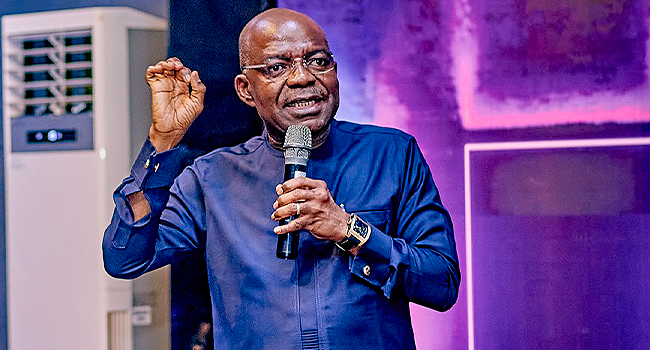
Abia State Governor Alex Otti has announced that the state is no longer affected by national grid collapses, citing a new initiative that converts organic waste into biogas for local power generation.
Speaking in Umuahia on Thursday, Governor Otti explained that his administration has negotiated an agreement with the Enugu Electricity Distribution Company (EEDC) to take over power distribution assets in the state. He added that on December 24, the Abia State Electricity Regulation Authority assumed regulatory control from the Nigerian Electricity Regulatory Commission (NERC), overseeing distribution, generation, and transmission locally.
The project is a pilot programme aimed at turning waste into clean energy, initially targeting the Umuahia industrial and agricultural zones. “Our state was not affected by recent national grid disasters because a significant part of our power assets is now under our authority,” Otti stated. The administration is currently sourcing funds to settle outstanding obligations with EEDC to finalise the transfer.
This state-led approach contrasts with the persistent instability of Nigeria’s national grid. The grid collapsed for the second time in 2026 earlier this week, causing widespread outages across the country. System failures are often linked to technical faults, inadequate infrastructure maintenance, and generation fluctuations. At one point, all 23 power plants disconnected, reducing national output to zero and leaving all 11 distribution companies without allocation.
Former presidential candidate Peter Obi criticised the latest collapse, describing it as part of a deepening national crisis. In a statement, he noted that Nigeria has ranked lowest globally for electricity access for three consecutive years, with nearly 100 million people without power. He contrasted Nigeria’s roughly 5,000 megawatts of generation with South Africa’s 40,000MW for 64 million people, Egypt’s 40,000MW for 115 million, and Algeria’s 50,000MW for 48 million. Obi attributed the crisis to governance failures and poor leadership in the sector.
The Nigeria National Grid (NNG) has responded by advocating metering and grid expansion as long-term solutions. It emphasised that accurate metering ensures revenue flow to generators, gas suppliers, and distributors, which can fund infrastructure upgrades and improve maintenance. Combined with transmission upgrades and reliable gas supply, these steps are seen as essential for stabilising supply.
While the national grid currently generates about 5,000MW—former Minister Babatunde Fashola once cited a technical capacity of 12,000MW—experts argue Nigeria requires over 30,000MW to meet demand for its 240 million people.
Governor Otti’s initiative represents a state-level attempt to circumvent national grid unreliability through renewable waste-to-energy projects. If successful, it could offer a model for other regions seeking energy independence, though it remains a pilot dependent on secured funding and full asset transfer. The broader challenge for Nigeria remains reforming its national power infrastructure to achieve consistent, widespread supply.


Comments are closed for this story.