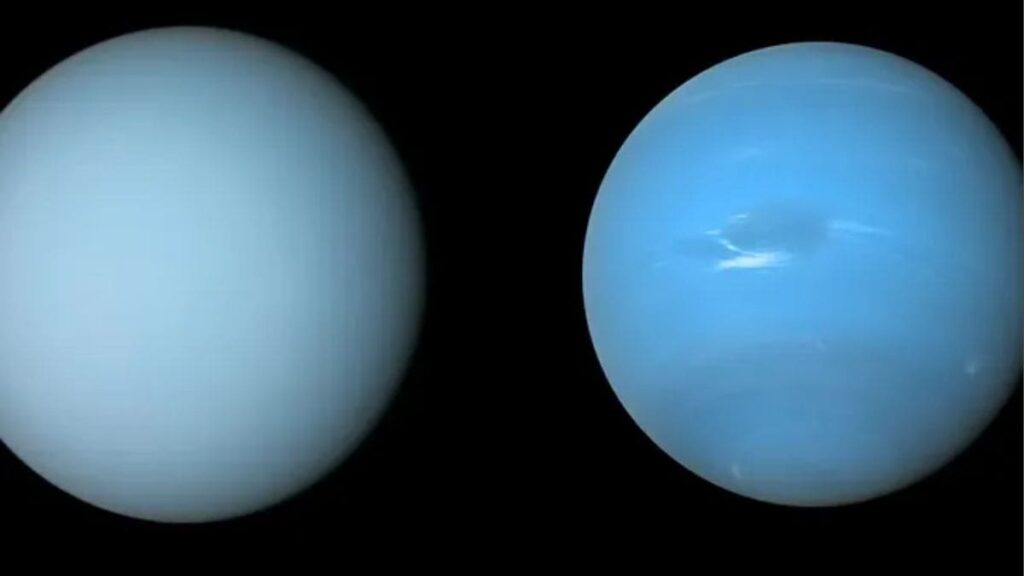
A new scientific analysis challenges the long‑standing classification of Uranus and Neptune as “ice giants,” suggesting that the two outer planets may be more akin to scaled‑down versions of gas giants such as Jupiter and Saturn. The study, conducted by an international team of planetary scientists, re‑examined the internal composition and formation histories of the distant worlds using the latest data from spacecraft observations, ground‑based telescopes and sophisticated computer models.
The researchers focused on the proportion of heavy elements – water, methane, ammonia and other volatiles – relative to hydrogen and helium in the planets’ interiors. Traditional models, built on limited data, posited that the bulk of Uranus and Neptune’s mass consists of a thick mantle of icy materials, underlying relatively thin atmospheres of hydrogen and helium. By integrating recent measurements of gravitational fields, magnetic signatures and atmospheric chemistry, the new work finds that the proportion of hydrogen and helium may be considerably larger than previously thought, while the amount of high‑pressure ices is lower.
These findings imply that the two planets could have formed in a manner more similar to Jupiter and Saturn, accreting substantial amounts of nebular gas before the solar nebula dispersed. If Uranus and Neptune indeed contain larger envelopes of hydrogen and helium, their internal structures would resemble mini‑gas giants rather than a distinct “ice‑giant” class. The study also addresses the puzzling differences between Uranus and Neptune – notably Uranus’s unusually low heat emission – by attributing them to variations in early impact histories rather than to fundamentally different compositions.
The re‑classification carries implications for how astronomers interpret the growing catalogue of exoplanets. Many discovered worlds fall within the size and mass range of Uranus and Neptune; they are commonly labeled “sub‑Neptunes” or “mini‑Neptunes” under the assumption that they are icy. If the Solar System’s own ice giants are in fact gas‑rich, the terminology used to describe exoplanets may need revision, influencing models of planetary formation and atmospheric evolution.
While the study reshapes scientific understanding, it does not overturn the observable characteristics of Uranus and Neptune – their blue‑green hues, extreme axial tilts and dynamic weather systems remain unchanged. Instead, it refines the picture of what lies beneath the visible clouds. The authors call for further missions to the ice‑giant region, emphasizing that in‑situ measurements of atmospheric composition, magnetic fields and interior dynamics are essential to resolve remaining uncertainties.
If future probes confirm a higher hydrogen‑helium content, textbooks and curricula worldwide may need to adjust the taxonomy of outer planets. For now, the debate underscores the evolving nature of planetary science, where each new dataset can prompt a reassessment of concepts once considered settled.