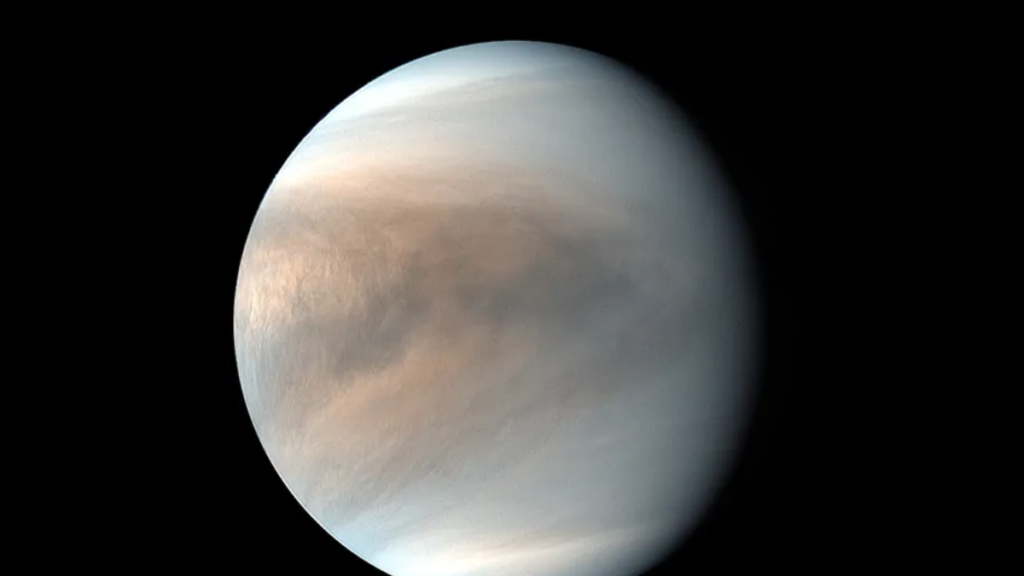
Scientists have resolved a long‑standing puzzle about the enigmatic ultraviolet (UV) markings that appear in Venus’s upper cloud deck. By applying a comprehensive “kitchen‑sink” approach that combined high‑resolution spacecraft imagery, laboratory spectroscopy and advanced atmospheric modelling, researchers identified sulfuric‑acid droplets infused with a previously unknown ultraviolet‑absorbing compound as the primary source of the dark patches.
The mystery dates back to the first flybys of Venus, when telescopes and early probes detected sharp, dark streaks in the planet’s otherwise bright cloud cover. These UV markings, which absorb roughly 40 percent of incident sunlight at wavelengths around 350 nm, have been linked to the planet’s extreme greenhouse effect and its super‑rotating atmosphere. Competing hypotheses proposed candidates ranging from unknown organic molecules to metallic vapours, but none could simultaneously match the spectral profile and the observed spatial variability.
The new study, conducted by an international team of planetary scientists, integrated data from the Akatsuki orbiter, which has been circling Venus since 2015, with laboratory measurements of candidate chemicals under Venus‑like pressures and temperatures. The researchers also employed three‑dimensional circulation models to test how different absorbers would distribute across the cloud layer.
Their experiments demonstrated that minute inclusions of ferric chloride (FeCl₃) suspended in sulfuric‑acid droplets reproduce the exact UV absorption signature recorded by Akatsuki’s 283‑nm and 365‑nm filters. Moreover, the model showed that atmospheric dynamics naturally concentrate these droplets in the western hemisphere, mirroring the asymmetric dark patterns seen in observations.
“This result is a breakthrough because it ties together the chemistry, the dynamics and the radiative balance of Venus’s clouds in a single, testable framework,” said the study’s lead author. “It also helps us refine estimates of the planet’s energy budget, which is crucial for understanding why Venus is so much hotter than Earth despite receiving similar solar flux.”
The findings have broader implications for comparative planetology. By pinpointing the composition of Venus’s UV absorbers, scientists can better constrain the chemical pathways that operate under extreme greenhouse conditions, offering clues about atmospheric evolution on both terrestrial and exoplanetary worlds.
Future missions, such as the planned VERITAS and EnVision orbiters, will carry spectrometers capable of directly sampling the cloud chemistry, providing an opportunity to confirm the presence of ferric chloride and to explore its formation mechanisms. Until then, the current work stands as the most comprehensive explanation to date for the planet’s striking ultraviolet veil.