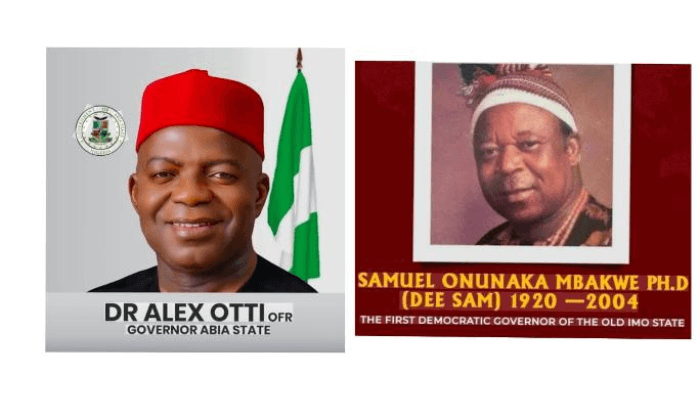
Do you know that history rarely produces leaders whose names become synonymous with development? In Nigeria’s post-independence political history, only a few governors have achieved that distinction. And, among them stands Dee Sam Mbakwe, whose tenure as Governor of the old Imo State between 1979 and 1983 permanently and to date altered public expectations of what purposeful leadership could accomplish.
One outstanding fact that can’t be erased is that even more than four decades after leaving office, Mbakwe’s name remains shorthand for visionary governance. It has been on record that across today’s Imo, Abia, Ebonyi and parts of Rivers State, the territories carved out of the old Imo State, roads, educational institutions, hospitals and industrial estates associated with his administration still shape public memory to date. His lasting and enduring legacy demonstrates an important principle that visibly shows that governments are remembered less for political speeches or white elephant projects in print than for institutions and infrastructure that survive them.
Today, a similar conversation is unfolding in Abia State. Governor Alex Otti, now in the middle of his first term, is increasingly being compared with the legendary Mbakwe. While noting that it is not a risk, such comparisons should neither be dismissed as political enthusiasm nor accepted as settled history. They deserve careful examination through the lens of governance, economics and institutional transformation. History ultimately rewards evidence, not sentiment.
The more important and inevitable question, therefore, is whether Abia is merely experiencing another burst of public infrastructure or whether it is witnessing the emergence of a developmental state that is strongly built and anchored on long-term economic transformation because the distinction truly matters.
Apt attention is drawn to the view that development economists have long argued that sustained economic growth depends not on isolated projects but on complementary investments in infrastructure, energy, institutions, human capital and productive enterprise. Roads without electricity rarely attract industries. Schools without jobs encourage migration. Fiscal discipline without investment suppresses growth. Successful governments integrate these sectors into a coherent development strategy.
Measured against this framework, Otti’s administration appears to be pursuing something more ambitious than conventional public works.
For decades, the majority of those in the know and who have visited could attest that Abia’s deteriorating road network represented the visible face of state failure. Aba, once known as the commercial heartbeat of the South-East and also one of Africa’s largest clusters of small and medium-scale manufacturers, gradually lost competitiveness as logistics costs rose and businesses struggled with decaying infrastructure.
Economic theory is unequivocal in that infrastructure reduces transaction costs, improves productivity and attracts private investment.
Recognising this reality, the Otti administration has made infrastructure renewal its most visible priority. By its third anniversary, the government reported completing more than 414 road projects covering over 860 kilometres, including strategic economic corridors such as Port Harcourt Road, Ohanku Road, Aguiyi Ironsi Boulevard, Omenuko Bridge and numerous urban and rural link roads.
The significance extends beyond asphalt. This is to say that every rehabilitated road lowers transport costs, improves market access, reduces vehicle operating expenses and enhances the competitiveness of manufacturers, Traders and farmers. There must be an understanding that infrastructure, in this context, becomes an economic policy rather than merely a construction programme.
The symbolism of these projects recalls Sam Mbakwe’s philosophy that public works should stimulate production rather than merely create political visibility. Like Mbakwe, Otti appears to recognise that infrastructure is not an end in itself but the foundation upon which economic prosperity is built.
If roads defined Mbakwe’s administration, reliable electricity may ultimately define Otti’s.
Few constraints have damaged Nigeria’s industrial competitiveness more than unreliable power supply. Recognising this, the administration has leveraged the Aba Integrated Power Project developed by Professor Barth Nnaji’s Geometric Power as a catalyst for wider economic transformation.
Development is rarely driven by isolated projects. It occurs when infrastructure complements infrastructure. Electricity powers factories. Roads move goods. Efficient transportation expands labour mobility. Water improves public Health. Digital infrastructure attracts investment. Together, they create an ecosystem capable of sustaining economic growth.
Professor Barth Nnaji’s disclosure adds another historical dimension to this story. Long before entering politics, Alex Otti played a critical role in securing financing for the Geometric Power Project during his banking career at First Bank and later Diamond Bank. He also helped facilitate the restructuring of the project’s foreign currency obligations from dollars to naira. This continuity suggests that Otti’s commitment to industrial infrastructure predates his governorship. Unlike politicians who discover development after assuming office, his engagement with productive investments appears rooted in decades of experience within Nigeria’s financial system.
One of the enduring criticisms of many Nigerian states is their dependence on monthly allocations from the Federation Account Allocation Committee (FAAC), with limited attention paid to expanding internally generated economic activity. Sam Mbakwe challenged that model through industrial estates and productive public investments.
Otti appears to be pursuing a twenty-first-century version of the same philosophy.
The proposed $145 million solar manufacturing plant in Isiala Ngwa South, government support for Ultimum Limited’s multimillion-dollar beverage manufacturing facility, efforts to operationalise the long-delayed Isiala Ngwa Inland Dry Port and continued urban renewal in Aba all point towards an Economy increasingly oriented towards production rather…