
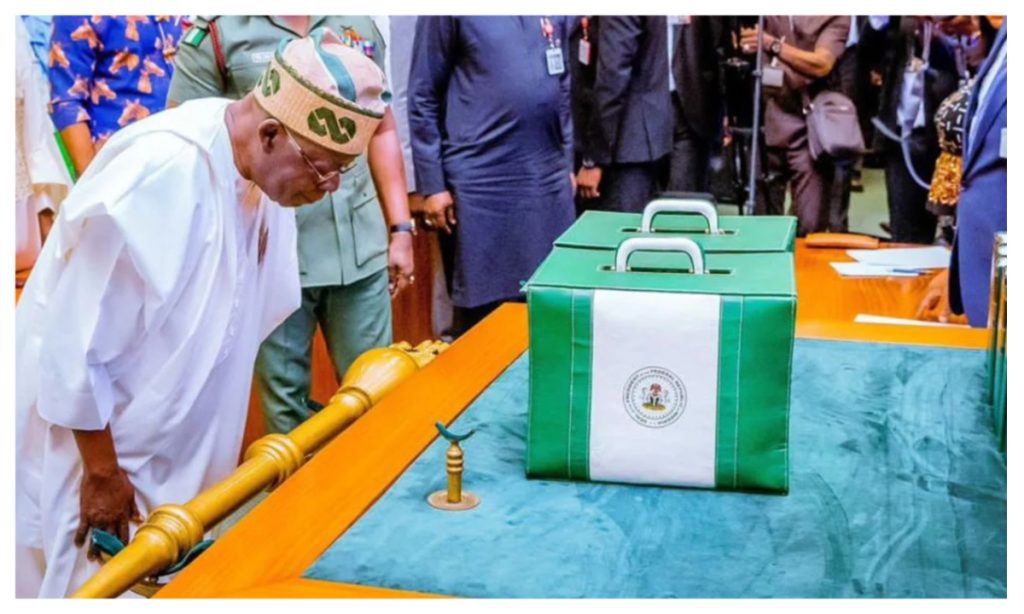
President Bola Ahmed Tinubu’s proposed N58.47 trillion budget for 2026 has sparked mixed reactions from economists, who have identified both strengths and weaknesses in the plan. The budget, presented to the National Assembly, allocates the highest amount to Security and Defense, with N5.41 trillion, followed by Infrastructure, Education, and Health, with N3.56 trillion, N3.52 trillion, and N2.48 trillion, respectively. The budget is based on projected revenue of N34.33 trillion, estimated expenditure of N58.18 trillion, and N15.52 trillion for debt servicing. Key assumptions include an oil price benchmark of $64.85 per barrel, daily production of 1.84 million barrels, and an exchange rate of N1,400 to the dollar. This represents a significant increase from the previous budgets, with N43.56 trillion and N54.99 trillion allocated for 2024 and 2025, respectively. Dr. Muda Yusuf, CEO of the Centre for the Promotion of Private Enterprise, described the 2026 budget as better structured than its predecessors, with more conservative and realistic assumptions. However, he cautioned that the oil price benchmark and production target may still be overly optimistic, given Nigeria’s historical performance. Yusuf also urged the National Assembly to resist inflating the budget with constituency projects, which can undermine implementation and public trust. Gbolade Idakolo, CEO of SD & D Capital Management, praised the budget’s focus on defense, infrastructure, education, and health, which are critical to investor confidence, job creation, and human capital development. He advised the National Assembly to subject the budget to rigorous scrutiny to ensure realism and prevent implementation gaps. The budget’s implementation is crucial, as the country seeks to stabilize and grow its economy. With a large portion of capital expenditure expected to roll over into 2026, timely release of funds is essential. The National Assembly’s scrutiny of the budget will be critical in ensuring that the allocations are realistic and effective in driving economic growth. The 2026 budget has the potential to address some of Nigeria’s pressing issues, including insecurity, infrastructure deficits, and human capital development. However, its success will depend on the government’s ability to implement the budget effectively, release funds on time, and ensure that the allocations are used efficiently. As the country moves forward, it is essential to track the budget’s implementation and hold the government accountable for its performance.
African Business News
2 min read
2026 Budget Tinubu Proposal Draws Mixed Reactions
President Bola Ahmed Tinubu’s proposed N58.47 trillion budget for 2026 has sparked mixed reactions from economists, who have identified both […]
More stories like this

African Business News
Analyst: Tinubu’s Reforms Stabilised Nigeria’s Economy

African Business News
Sycamore gets microfinance bank licence
African Business News
High borrowing costs threaten banks’ credit expansion

African Business News
Comments are closed for this story.