
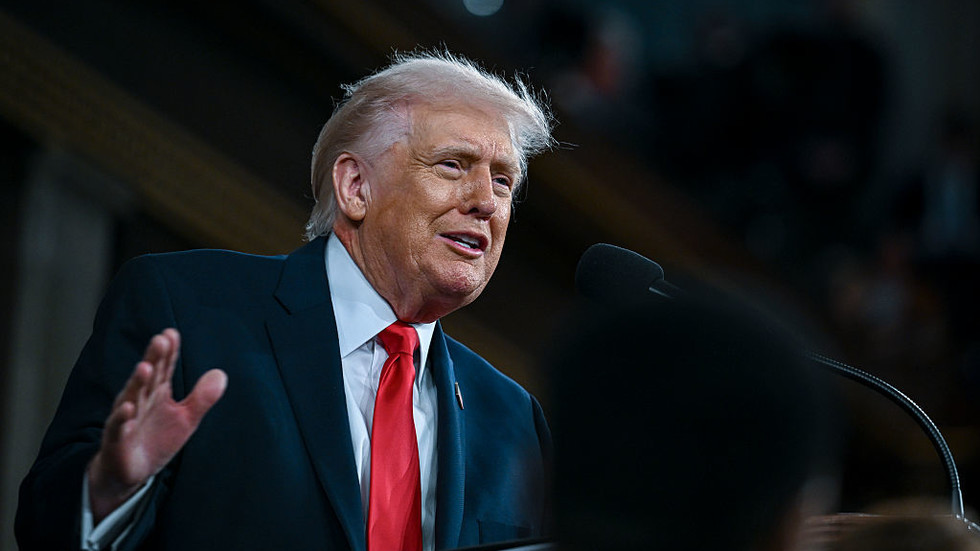
President Donald Trump delivered the longest State of the Union address in modern history, a 1 hour and 49 minute speech defending his administration’s record and outlining priorities ahead of the 2026 midterm elections. Speaking to a joint session of Congress on Tuesday, the first such address of his second term, Trump framed his remarks around America’s upcoming 250th anniversary, declaring the nation was in a “Golden Age” and “respected again.”
The speech centered on economic and border security themes, with Trump claiming sharp declines in inflation and illegal border crossings. He attributed economic gains to tax cuts, deregulation, and tariffs, stating core inflation fell to 1.7% in late 2025. While inflation has cooled from its 2022 peak above 9%, it has hovered near the Federal Reserve’s 2% target. Trump also pointed to stock market gains and private investment as recovery evidence, though his assertion that he inherited historically high inflation contradicts data from the 1970s and early 1980s.
A significant portion addressed tariffs and trade. Trump criticized a recent Supreme Court ruling that struck down key parts of his “reciprocal” tariff policy, which had been imposed using emergency powers. He announced a new 10% global tariff under alternative legal authority, suggesting such measures could eventually replace income taxes—a prospect the EU warns could raise prices and harm the global economy.
On immigration, Trump asserted the US now has the “strongest and most secure border in American history,” citing reduced crossings and fentanyl trafficking. Official data shows a sharp decline from previous peaks. He did not mention Immigration and Customs Enforcement (ICE), despite its central role in ongoing enforcement debates.
Domestically, Trump urged Congress to pass the “Save America Act,” which would require proof of citizenship for voter registration and mandate voter ID. He alleged widespread election cheating, a claim rejected by Democrats who argue such laws could disenfranchise eligible voters. He also called for restrictions on gender-related medical care for minors without parental consent, framing it as a parental rights issue.
Foreign policy occupied a smaller segment. Trump referenced a US military operation against Iranian nuclear facilities and expressed a diplomatic preference while vowing to prevent Iran from obtaining a nuclear weapon. He reiterated his “peace through strength” doctrine, urging NATO allies to increase defense spending to 5% of GDP. On Ukraine, he repeated his claim the war would not have started under his leadership and said his administration is working to end it, without detailing new initiatives. He also praised a Mexican operation that killed cartel leader ‘El Mencho’ and referenced the US removal of Venezuelan President Nicolas Maduro, an action condemned by Venezuela and others as a kidnapping.
Concluding with an ethics proposal, Trump called for legislation to ban stock trading by members of Congress, singling out former Speaker Nancy Pelosi. He argued such practices erode public trust.
The address, delivered amid Democratic protests and boycotts, served as a comprehensive defense of Trump’s agenda, blending economic nationalism, security hardline policies, and institutional critiques as his party prepares for the 2026 elections. Its unprecedented length underscored the breadth of his political and policy agenda.

Comments are closed for this story.