
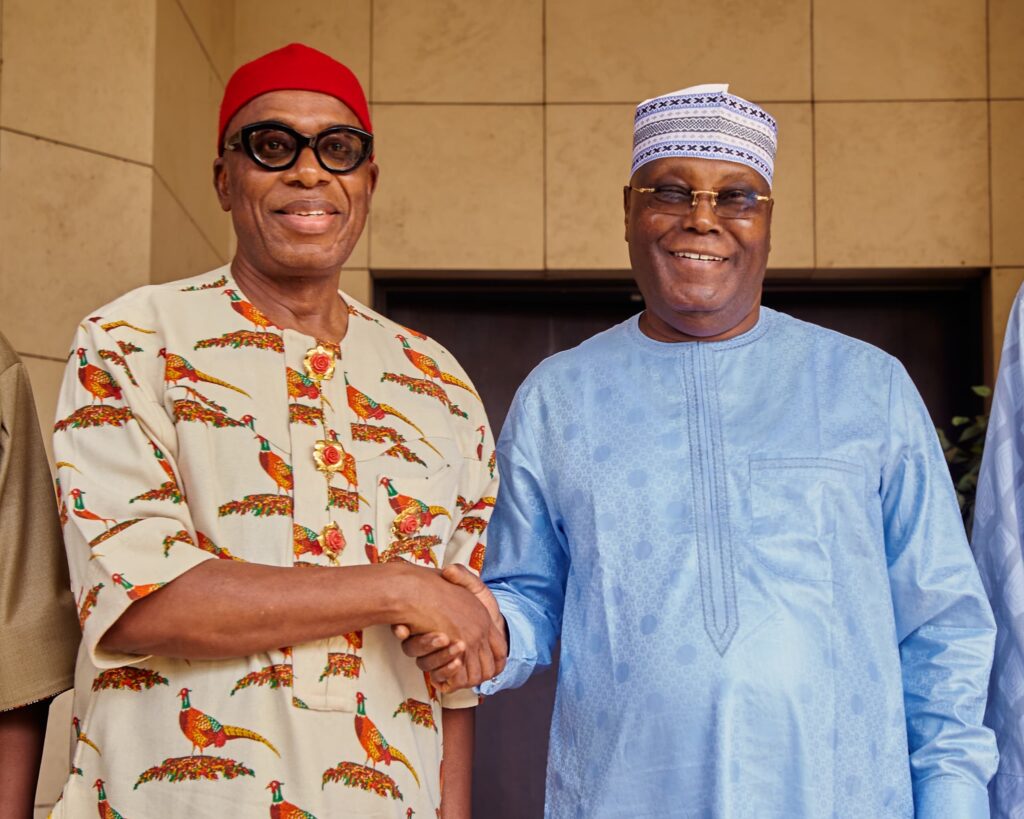
Former Vice President Atiku Abubakar lauded the public‑service record of former Governor and Minister Rotimi Amaechi on Wednesday, describing the northern politician as a “statesman” whose contributions continue to shape Nigeria’s political landscape.
Atiku shared a brief statement on X after meeting Amaechi at his Abuja residence. He said the encounter was “engaging and fruitful” and praised the hospitality extended to him and his delegation. “I remain deeply grateful for the warmth, grace and generosity of spirit with which he received me and my delegation,” the former vice president wrote.
The post highlighted Amaechi’s extensive experience, noting his tenure as a two‑time Speaker of the House of Representatives, a two‑time Governor of Rivers State and a two‑time minister in former President Muhammadu Buhari’s cabinet. Atiku asserted that such a record “continues to echo in the annals of our national life,” underscoring the former governor’s lasting influence on national affairs.
Both politicians are widely reported to be positioning themselves for the upcoming presidential contest under the banner of the African Democratic Congress (ADC). While the ADC has yet to formalise its ticket, the public admiration expressed by Atiku may signal an effort to build a broader coalition ahead of the 2027 election cycle.
Rotimi Amaechi, who served as Minister of Transportation (2015‑2019) and later as Minister of Petroleum Resources (2021‑2023), has been a prominent figure in the Niger‑Delta region’s development agenda. His earlier legislative work includes chairing the House Committee on Appropriations, where he was instrumental in budgetary reforms. The meeting with Atiku, a veteran of Nigeria’s political arena and former presidential candidate, could be viewed as an alignment of senior leaders with complementary regional bases.
The interaction comes at a time when Nigeria’s major parties are recalibrating strategies ahead of the 2027 general elections. The ADC, a smaller opposition party, seeks to improve its national profile by attracting high‑profile politicians. Atiku’s public endorsement of Amaechi’s statesmanship may enhance the party’s credibility among voters seeking experienced leadership.
Observers note that such engagements, while diplomatic, often serve to gauge mutual support and potential power‑sharing arrangements. Whether the two will ultimately join forces on the ADC ticket remains to be seen, but the meeting underscores the fluid nature of alliances in Nigeria’s evolving political landscape.

Comments are closed for this story.