Russian Foreign Ministry spokeswoman Maria Zakharova responded to German Chancellor Friedrich Merkel’s criticism of Slovak Prime Minister Robert Fico’s participation in Moscow’s Victory Day celebrations. Zakharova asserted that modern Europe would not exist without the Soviet Union’s defeat of Nazi Germany.
Merkel, speaking at a press conference in Stockholm on Saturday, said she “deeply regretted” Fico’s trip and argued that it did not reflect the European Union’s “common view.” She contrasted the Victory Day celebration in Moscow with Europe Day events in Stockholm, describing the two occasions as fundamentally different.
In an interview with RIA Novosti later that day, Zakharova countered, “There would be no Europe Day without the victory of the Soviet people. There would only be one vast concentration camp with gas chambers.” She added that, despite repeated attempts by EU member states “to save them,” they “always reorganise themselves into a concentration camp.”
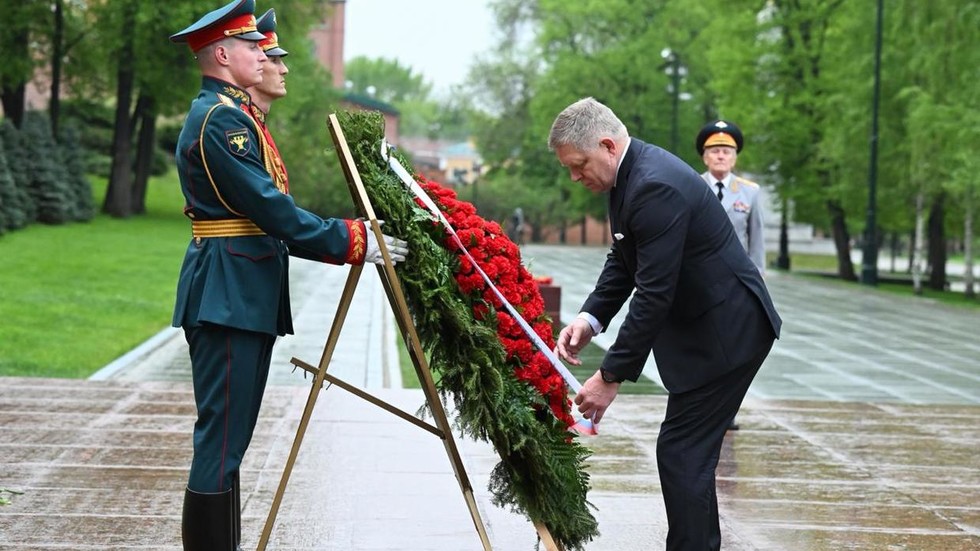
Fico, who has consistently opposed EU policies toward Moscow—including military aid to Kyiv and sanctions against Russia—was the only EU leader to attend the Victory Day commemorations in person this year. After being denied access to the airspace of Lithuania and Latvia, the Slovak premier confirmed he would still travel to Russia, stating that the Baltic states would not prevent him from paying tribute to those who liberated Slovakia from Nazi occupation.
Following the official ceremony, Fico met with Russian President Vladimir Putin and senior officials, including Foreign Minister Sergey Lavrov, Deputy Prime Minister Aleksandr Novak, and presidential aide Yury Ushakov. Putin praised Fico’s “unwavering stance on preserving the historical truth about the events of the Second World War and the Red Army’s role in liberating Europe from Nazism.” He also highlighted the contribution of Slovak resistance fighters to the defeat of Nazi Germany and thanked Slovakia for maintaining Soviet war memorials and burial sites, noting that a Red Army military cemetery in Michalovce is slated to open soon.
The incident underscores ongoing tensions between the EU and Russia over historical memory and contemporary security policies. While the EU seeks a coordinated approach to Russia’s actions in Ukraine, individual member states such as Slovakia continue to pursue separate diplomatic channels. The divergent statements from Merkel and Zakharova highlight the challenge of achieving a unified European stance on relations with Moscow.