
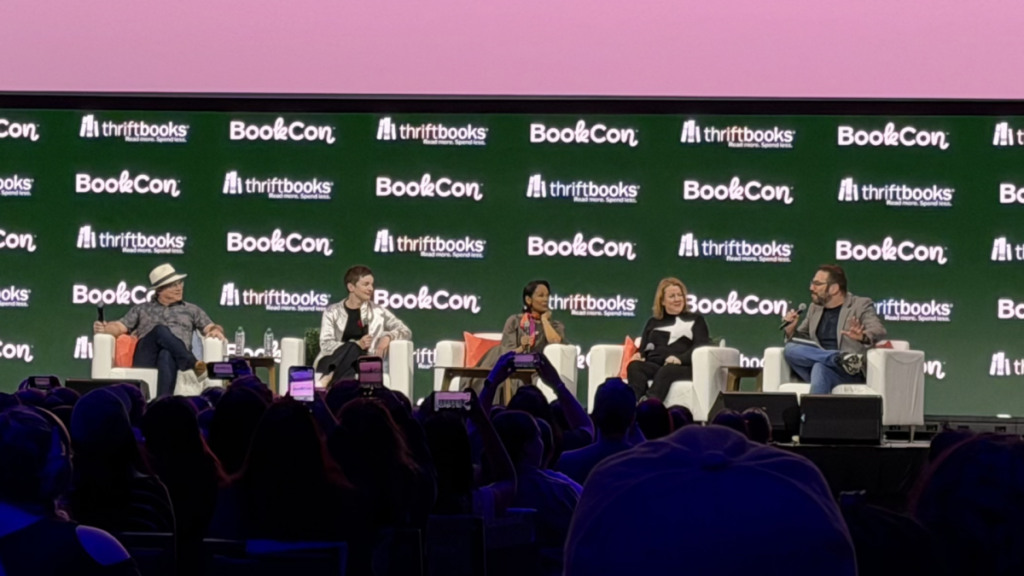
BookCon 2026 closed with a lively panel of bestselling authors discussing the realities of seeing their novels adapted for screen. Authors Andy Weir (*Project Hail Mary*, *The Martian*), Emily St. John Mandel (*Station Eleven*), May Cobb (*The Hunting Wives*), and Robinne Lee (*The Idea of You*) joined moderator Jason Blitman to explore what makes an adaptation work—and why authors are often more open to change than fans might expect.
Blitman opened by asking what defines a successful adaptation. The authors’ experiences varied: Weir and Cobb had seen faithful versions of their work, while St. John Mandel and Lee’s adaptations took greater liberties with plot and character. Mandel noted that *Station Eleven* changed “every single plot” but retained the original’s spirit. Lee emphasized the challenge of balancing fidelity to readers with broader audience appeal.
Despite potential creative differences, the authors expressed a shared lack of possessiveness over adaptations. “I feel like I’m almost pathologically welcoming of changes in the adaptation process,” Mandel said. Cobb recalled enthusiastically embracing a proposed ending change for *The Hunting Wives* after her producer pitched a new vision during a visit to East Texas. Weir revealed he maintains a list of potential improvements for his novel *Artemis*, ready to offer if the project moves forward.
The panel highlighted the inherent differences between books and visual media. Weir explained that visual storytelling allows for expansions and changes that would be difficult to achieve in prose. Cobb found that screen adaptations could develop secondary characters in new ways, while Lee likened adaptations to “distant relatives” of the original work—related, but distinct. The authors agreed that, although fans may resist changes, their own approach is pragmatic and collaborative. “You have to look at any adaptation as a kind of distant relative,” Lee said, noting that criticism of an adaptation feels less personal than critique of the book itself.
BookCon 2026, held April 10‑11, concluded with this discussion, underscoring the evolving relationship between literature and screen. The event will return in 2027, continuing to bring together authors, readers, and industry professionals.


Comments are closed for this story.