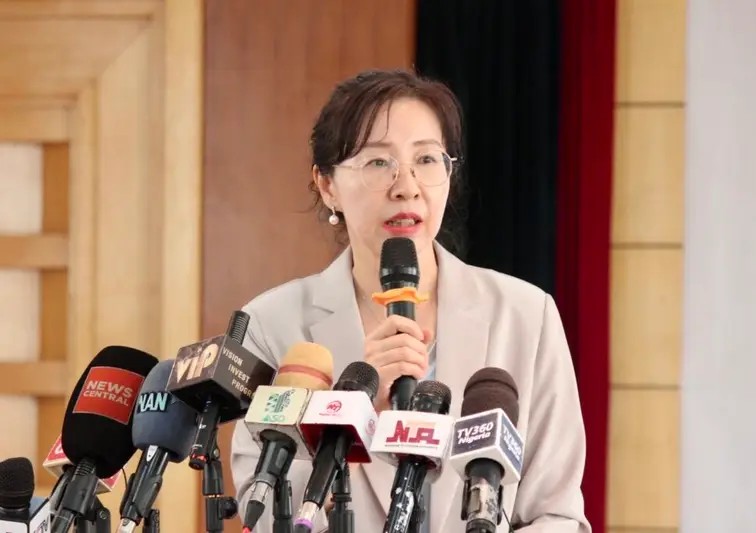
Dong Hairong, a counsellor at the Chinese Embassy in Abuja, urged Nigeria to deepen its support for the One‑China principle after a media salon on Thursday that examined the policy’s role in China‑Nigeria relations. The event, titled “Understanding the One‑China Principle and Its Role in Deepening China–Nigeria Strategic Relations,” was jointly organised by the Centre for China Studies and the Centre for Contemporary China‑Africa Research.
Dong condemned the recent visit of Taiwan’s leader, Lai Ching‑te, to Eswatini, describing it as an attempt to internationalise separatist activity. She also raised concerns about a delegation of Nigerian journalists who travelled to Taiwan and met officials from its external affairs department.
According to Dong, Taiwan has been an inseparable part of China since ancient times, and the People’s Republic of China remains the sole legitimate government representing China internationally. She cited the United Nations General Assembly Resolution 2758 (1971) as the legal basis confirming Beijing’s position on Taiwan and noted that 183 countries, including Nigeria, have diplomatic relations with China on the One‑China premise.
Dong reiterated that Nigeria has consistently affirmed the One‑China principle since establishing diplomatic ties with Beijing in 1971, and that the principle underpins the broader China‑Africa partnership. “China expects all sectors of Nigerian society to firmly uphold the One‑China principle and protect China’s core interests and territorial integrity,” she said.
The diplomat highlighted several areas of growing China‑Nigeria cooperation, including infrastructure, trade, agriculture, technology and education. She referenced flagship projects such as the Lekki Deep Sea Port, rail link developments and the recently inaugurated ECOWAS headquarters in Abuja, all built with Chinese assistance. Dong also noted China’s recent zero‑tariff treatment for exports from 53 African countries that maintain diplomatic relations with Beijing, a policy she said will expand market access for Nigerian commodities such as sesame, ginger, cocoa and cashew nuts.
Public affairs analyst Dr Segun Showunmi said Nigeria’s backing of the One‑China principle has translated into tangible benefits, citing rail projects, airport expansions and the Lekki port as outcomes of the partnership. Prof Sheriff Ibrahim, provost of the Anti‑Corruption Academy of Nigeria and head of Contemporary China‑Africa Research, added that African nations continue to support the principle because it reflects shared values on sovereignty and territorial integrity. He noted that 53 of Africa’s 54 countries have adhered to the policy, with Eswatini the sole exception maintaining diplomatic ties with Taipei.
Charles Onunaiju, director of the Centre for China Studies, described the One‑China principle as rooted in historical facts and international consensus, while Prof Sam Amadi, dean of the law faculty at Ave Maria University, distinguished between the “One‑China principle” promoted by Beijing and the “One‑China policy” adopted by individual states. Amadi cautioned African countries against formal diplomatic relations with Taiwan, urging them to manage economic engagement in line with international norms and national interests.
The remarks come as Nigeria seeks to balance its strategic partnership with China against growing interest from Taiwan in the continent. How Abuja navigates this diplomatic terrain will influence the scope of future infrastructure projects, trade opportunities and political cooperation between the two nations.