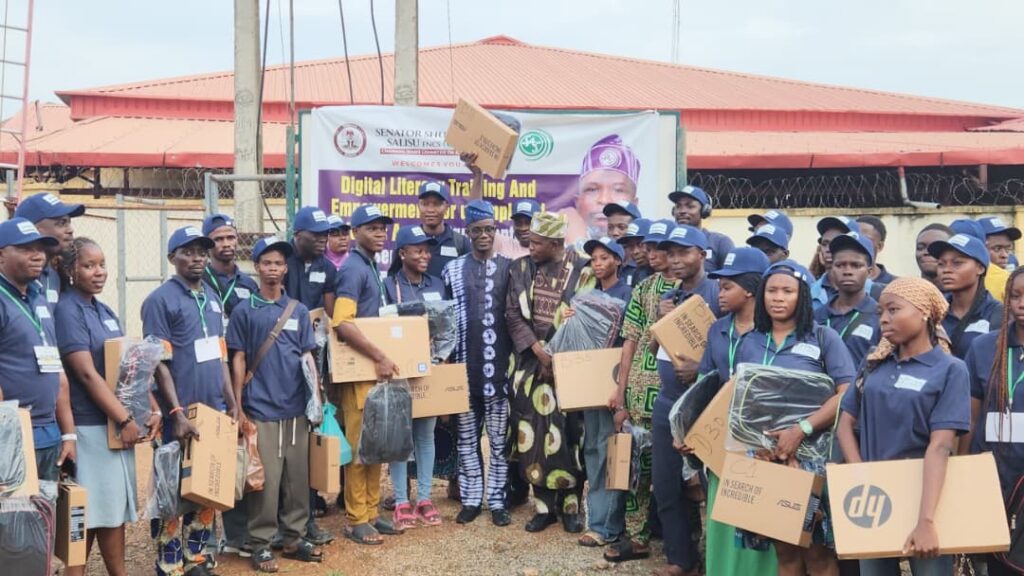
Senator Shuaib Afolabi Salisu, who represents Ogun Central and chairs the Senate Committee on ICT and Cybersecurity, warned that Nigeria’s legal and governance frameworks must be overhauled to match the realities of the global digital economy. Speaking at the close of a two‑week digital‑skills training programme in Abeokuta, he said the country’s laws remain “analogue” while the world moves increasingly online.
The programme, organised jointly by the National Information Technology Development Agency and the Federal Ministry of Communications, Innovation and Digital Economy, brought together about 350 young participants from across the district. Over the first week, trainees received virtual instruction in cybersecurity, content creation and other digital competencies; the second week comprised hands‑on sessions, after which each participant was handed a laptop. Salisu stressed that the laptops were distributed only after thorough training to prevent them from being resold.
“The future belongs to those who embrace technology,” the senator told the closing ceremony at the JAMB office in Oke‑Mosan. “We need to focus on two things – education and ICT skills.” He added that citizens lacking digital proficiency are at a disadvantage in today’s economy, where platforms and online services are becoming the backbone of commerce.
Salisu highlighted the National Digital Economy and E‑Governance Bill, now in its final parliamentary stage, as a cornerstone of his legislative agenda. He described the draft law as a “legacy project” aimed at modernising governance, creating a regulated environment for electronic transactions, mandating the digitisation of government services, and establishing a national digital exchange to enable seamless sharing of citizens’ data among agencies. He expressed confidence that the bill will be passed and signed before the National Assembly recess later in the year.
The senator also reflected on Nigeria’s progress in digital infrastructure. He cited the Joint Admissions and Matriculation Board’s electronic admission system, which has attracted delegations from other African nations, as evidence of the country’s growing technological capability. Ongoing federal investments in broadband, particularly the fibre‑optic expansion project, are expected to improve connectivity and lay the groundwork for future initiatives such as electronic voting.
While acknowledging that further work is needed, Salisu’s remarks underscore a governmental push to align Nigeria’s legal framework and public services with the digital era, positioning the nation to compete more effectively in the global digital economy.